
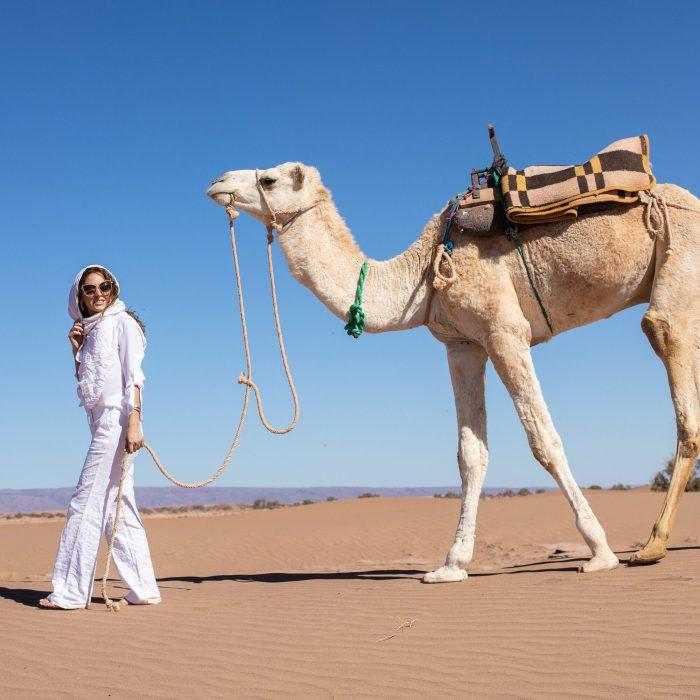
In short: For the Moroccan desert, dress in loose, breathable layers that cover your skin from the strong sun by day, and pack a warm jacket for cold desert nights. There is no strict rule for tourists, but modest, light-coloured clothing keeps you comfortable and respectful in rural areas.
What should I actually wear in the Sahara?
The winning formula is simple: cover up, but keep it loose. On my first trip out to Erg Chebbi near Merzouga, I made the classic mistake of wearing shorts and a tank top — and regretted it by mid-morning. The sun reflects off the sand and burns fast. Long, lightweight cotton or linen trousers and a loose long-sleeved shirt actually keep you cooler than bare skin, because they block direct sun and trap a little shade against your body. Light colours (beige, white, sand) beat black, which soaks up heat. A wide-brimmed hat or the classic cotton scarf (chèche) wrapped as a turban is not just for photos — it genuinely shields your neck and face from sun and blowing sand.
How cold does the desert get at night?
This is what catches most people out. During the best travel season (October to April), daytime temperatures are pleasant, but once the sun drops behind the dunes the temperature can plummet 15–20°C in a couple of hours. Winter desert nights near Merzouga or in remote Erg Chigaga (reached by 4×4 from M’Hamid) can hover near freezing. A warm fleece or padded jacket, a beanie, and thick socks are essential if you are sleeping in a desert camp. In summer, by contrast, days soar past 40°C and even nights stay warm — but October to April is the season most travellers pick precisely to avoid that heat.
Dress code for women
Morocco is relatively relaxed, and no head covering is required for female travellers. That said, rural desert villages between Marrakech and Merzouga (~560km, 9–10 hours, usually done as a 3-day tour) are conservative, so covering shoulders and knees avoids unwanted attention and shows respect. Loose maxi dresses, wide linen trousers, and tunics work beautifully — they are cool, modest, and easy to layer. Bring a light scarf: it doubles as sun protection, a shoulder cover when visiting a village or kasbah, and a wrap for the camel trek. For the camel ride up the dunes, trousers are far more comfortable than a dress.
Dress code for men
Men have it easy but should still skip the beachwear look inland. Long lightweight trousers and breathable shirts are ideal; shorts are fine around the camp or pool but feel out of place in towns and villages. Many men buy a chèche scarf locally (a few euros in the souks) and learn to wrap it — genuinely useful when the wind picks up sand. A light jacket for the evening completes the kit whether you are on the shorter Marrakech–Zagora route (~360km, ~7h, common as a 2-day tour) or the long haul to Erg Chebbi, where the tallest dunes reach about 150m.
What about footwear and the dunes?
Closed shoes or trainers are best for the drive, village walks, and rocky terrain. But for climbing the dunes themselves, many people go barefoot — sand pours into any shoe within seconds. Sandals are handy around camp. Whatever you bring, expect it to end up full of fine sand, so leave your best white sneakers at home. Sunglasses (ideally wraparound) and high-SPF sunscreen are non-negotiable.
Does the Agafay desert need different clothing?
Slightly. Agafay, just 40 minutes from Marrakech, is a rocky stone desert — not Saharan dunes — so you get lunar-style hills rather than soft sand. The same loose, sun-smart layers apply, but sturdy closed shoes matter more here because the ground is stony rather than sandy. Evenings still turn cool, so bring a jacket. For the full picture of routes, camps and seasons, see our Morocco Desert guide, and this related guide for planning your itinerary.
Frequently Asked Questions
Do women have to cover their hair in the Moroccan desert? No. Head covering is not required for tourists. A scarf is useful for sun and sand and as a respectful cover in conservative villages, but it is your choice.
Can I wear shorts in the desert? You can, but long loose trousers protect you better from sun and heat, and are more appropriate in rural towns. Save shorts for around the camp or pool.
What do I need for a night in a desert camp? Warm layers — a fleece or jacket, hat and thick socks — especially October to April when nights get cold. Also a headlamp and a change of clothes free of sand.
How much does a desert tour cost? A shared 3-day Merzouga tour typically runs around 80–150 EUR per person, depending on group size and camp comfort. Private tours cost more.
Is the clothing different for Fes departures? No, the dress code is the same. Fes–Merzouga is shorter (~470km, 7–8 hours) than the Marrakech route, but you still need sun layers by day and warm layers at night.
👉 Planning your trip? Ask our local agency on WhatsApp.
Planning your trip? Explore our Morocco desert tours from Marrakech, 3-day Marrakech to Merzouga tour and 2-day Zagora tour.