
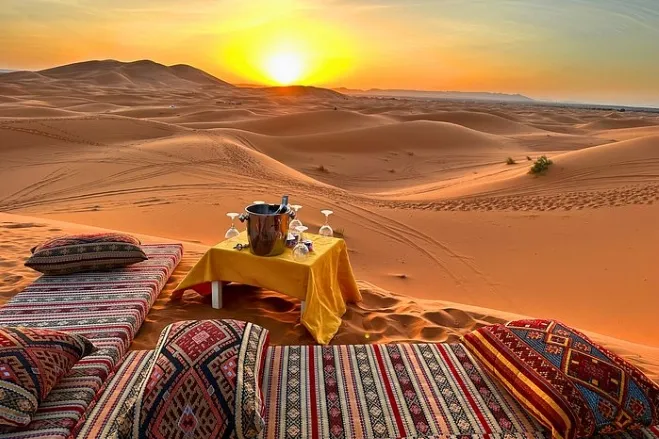
Comparing camps? See all our Agafay desert camps, how to choose the right camp and the Agafay day pass guide.
All our tours are private. These prices are for a private experience, not a shared group. We confirm the exact price on WhatsApp; you book directly with the local families and camps, no middlemen.
In short: The best desert camps for stargazing in Morocco sit deep in the Sahara at Erg Chebbi (near Merzouga) and remote Erg Chigaga (near M’Hamid), where zero light pollution and dry desert air give you brilliant, naked-eye star fields. Aim for October to April on a moonless night, and expect a shared 3-day Merzouga tour to run roughly 80-150 EUR per person.
Why is the Moroccan Sahara so good for stargazing?
What makes the deep desert special is simple: no cities, no streetlights, and bone-dry air. Around the dunes of Erg Chebbi and Erg Chigaga you are hours from the nearest town, so once the sun drops the sky just fills in. On a clear winter night the Milky Way is an obvious smear overhead, not something you have to squint for. The best moments I have had were lying back on a still-warm dune well after dinner, when the camp lanterns are dimmed and your eyes finally adjust. Dry air also means less haze near the horizon, so you catch stars low in the sky that would vanish in more humid coastal spots.
Which desert region should you pick: Erg Chebbi or Erg Chigaga?
Erg Chebbi, reached via Merzouga, is Morocco’s most famous dune sea and home to the country’s tallest dunes at roughly 150 metres. It is the easier choice: plenty of camps, a well-worn road, and dunes big enough to block any distant glow. Erg Chigaga, near M’Hamid at the end of the Draa Valley, is the wilder option. You reach it only by 4×4 across open desert, and because so few camps exist out there, the darkness and silence feel more absolute. If it is your first Sahara trip, Merzouga is the practical pick; if you want remoteness and are willing to work for it, Chigaga rewards you. For the full lay of the land, see our Morocco Desert guide.
How do you actually get to the dunes from Marrakech or Fes?
Distance is the thing most travelers underestimate. Marrakech to Merzouga is about 560 km and takes 9-10 hours of driving, which is why it is almost always sold as a 3-day tour with an overnight in the Dades or Todra gorges along the way. From Fes the run is shorter, around 470 km and 7-8 hours, so a 2-day trip is more realistic. If your time is tight, Marrakech to Zagora is only about 360 km and roughly 7 hours, commonly done as a 2-day tour, though Zagora’s dunes are smaller and closer to town than Erg Chebbi’s. For stargazing specifically, the extra drive to Merzouga or Chigaga is worth it.
Isn’t Agafay a desert too?
Agafay comes up constantly because it is only about 40 minutes from Marrakech, and its camps do offer lovely dark-sky evenings without the long haul. But be clear on what it is: Agafay is a rocky, stone desert of pale hills, not a Sahara dune sea. There are no tall sand dunes there. The trade-off is honest, less than an hour versus a full day of driving, but no golden erg to climb at sunrise. If you only have one night and want stars near the city, Agafay works; if the sand dunes are the dream, you need the real Sahara. Our related guide breaks down the difference in more detail.
When is the best time of year for a clear night sky?
The sweet spot is October through April. Summer in the Sahara is brutal, daytime highs push past 40C, and the heat lingers into the evening, which is uncomfortable for sitting out under the stars. The cooler months give you crisp, stable air and long dark evenings. The catch is that winter desert nights get genuinely cold once the sun is down, so pack a warm layer even if your afternoon was mild. Camps provide heavy blankets, but a fleece and a hat make the late-night sky sessions far more pleasant. For the darkest skies, plan your overnight around the new moon, when there is no moonlight to wash out fainter stars.
What should you expect from a stargazing camp?
Camps range from simple tented sites to plush setups with proper beds and private bathrooms, and the price tracks that comfort. A shared 3-day Merzouga tour typically lands in the 80-150 EUR per person range, usually covering transport, one or two camp nights, dinner, and breakfast. For the best star experience, ask two things before booking: whether the camp keeps lighting low after dinner, and how far it sits from Merzouga village. The more remote and the darker the camp keeps its grounds, the better your view. A camel ride out at dusk, dinner under the tents, then a quiet hour on the dunes is the classic rhythm, and it is worth staying up past when the group drifts off to bed.
Frequently Asked Questions
Can you see the Milky Way with the naked eye? Yes. On a clear, moonless night at Erg Chebbi or Erg Chigaga the Milky Way is easily visible without any equipment, along with countless stars and the occasional shooting star.
Do I need a telescope? No. The naked-eye view is the main event. Bring binoculars if you have them for a closer look at star clusters, but nothing is required.
How cold does it get at night? In winter, desert nights can drop close to freezing even after a warm day. Camps supply blankets, but bring a warm jacket, hat, and closed shoes for the evening.
Is a full-moon night bad for stargazing? A bright full moon washes out fainter stars, so if dark skies matter most to you, book your overnight near the new moon.
Which is better for stars, Merzouga or Agafay? Merzouga, deep in the Sahara, is darker and more remote. Agafay is far closer to Marrakech and still dark, but it is a stone desert with no dunes.
👉 Planning your trip? Ask our local agency on WhatsApp.