
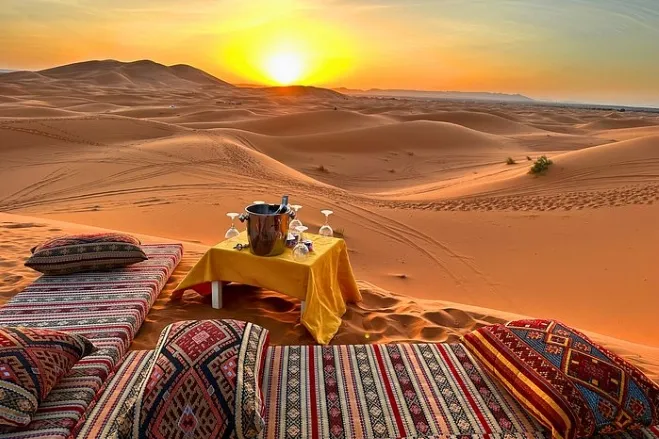
In short: The Moroccan Sahara around Merzouga and Erg Chigaga offers some of the darkest, driest skies in North Africa, and desert camps run telescope nights that reveal the Milky Way, planets and star clusters with the naked eye. The best stargazing runs October to April, when nights are crisp, cloudless and moon-timed for maximum darkness.
Why is the Moroccan Sahara so good for astronomy?
Three things make the Sahara a genuine dark-sky destination: distance from cities, altitude and dry air. Out at Erg Chebbi near Merzouga, the nearest real light pollution is hours away, and the desert sits at roughly 800-900m with very low humidity, so the atmosphere is steady and transparent. On my first night at a Merzouga camp the Milky Way rose like a bright band of smoke over the dunes, and I could pick out the Andromeda galaxy as a faint smudge without any equipment. Erg Chigaga, the remoter dune sea reached by 4×4 from M’Hamid, is even darker because there are almost no fixed buildings around it at all.
Where do the best telescope nights happen?
Two regions dominate. Merzouga, home to Erg Chebbi and its tallest dunes at around 150m, is the most accessible and has the most camps offering organised astronomy sessions. It sits roughly 560km (9-10 hours) from Marrakech, usually done as a 3-day tour, or about 470km (7-8 hours) from Fes. Erg Chigaga, near M’Hamid at the end of the Draa Valley, is the wilder option for travellers who want zero infrastructure between them and the horizon. If you only have two days, Zagora (about 360km and 7 hours from Marrakech) is closer but its dunes and darkness are more modest than Merzouga’s.
A quick note for Marrakech-based travellers short on time: the Agafay is a rocky, stony desert just 40 minutes from the city, not sand dunes. Its skies are darker than the city’s but nowhere near as pristine as the deep Sahara, since Marrakech’s glow still sits on the horizon.
What will I actually see through the telescope?
It depends on the season and the moon, but a good camp guide will usually start with the naked-eye Milky Way, then swing a telescope toward whatever planets are up, most often Jupiter with its four bright moons or Saturn’s rings, which draw the loudest gasps. Deep-sky targets like the Pleiades, the Orion Nebula in winter, and star clusters come out beautifully in the dry air. Bring a small pair of binoculars if you have them, because sweeping the Milky Way with binoculars from a dune is a memory that sticks. Shooting stars are common; the Perseids in mid-August and the Geminids in mid-December are the standout meteor showers.
When should I go, and how cold does it get?
Aim for October to April. Summer daytime heat routinely tops 40C, which makes travel punishing even though summer nights can be clear. Winter delivers the cleanest, most transparent skies, but desert nights get genuinely cold, often near or below freezing once the sun drops, so pack a warm layer, a hat and gloves even if your afternoon was warm. Time your trip to the new moon or the days around it: a bright full moon washes out the fainter stars, while a moonless night is when the Milky Way truly blazes. For deeper planning, see our Morocco Desert guide.
How much does a stargazing desert trip cost?
Astronomy is usually folded into a standard desert tour rather than sold separately. A shared 3-day Marrakech-Merzouga tour typically runs around 80-150 EUR per person, covering transport, a night in a desert camp and meals. Private tours, luxury camps with dedicated telescopes and astronomer guides, or Erg Chigaga 4×4 expeditions cost more. Ask specifically whether your camp provides a telescope and a guide who knows the sky, because many basic camps rely on the naked-eye view alone, which is still spectacular but different from a guided session. Our related guide breaks down tour formats in more detail.
Frequently Asked Questions
Do I need my own telescope? No. Bringing one across Morocco is impractical, and better camps supply telescopes. Confirm before booking, and pack binoculars as a lightweight backup.
Is the Agafay good for stargazing? It is convenient at 40 minutes from Marrakech and darker than the city, but it is a rocky desert with the city’s glow nearby, so the deep Sahara around Merzouga or Erg Chigaga is far better for serious astronomy.
What is the single best time for the darkest skies? A clear, moonless night between October and April. Check the moon phase and aim for the new moon window.
Can I photograph the Milky Way? Yes. Bring a camera with manual mode, a fast wide lens and a small tripod. The dry, dark air makes long-exposure astrophotography excellent, especially over the Erg Chebbi dunes.
How cold will the night be? In winter, expect near-freezing temperatures after dark despite warm days. Camps provide blankets, but bring a warm jacket, hat and gloves.
👉 Planning your trip? Ask our local agency on WhatsApp.
Planning your trip? Explore our Morocco desert tours from Marrakech, 3-day Marrakech to Merzouga tour and 2-day Zagora tour.