
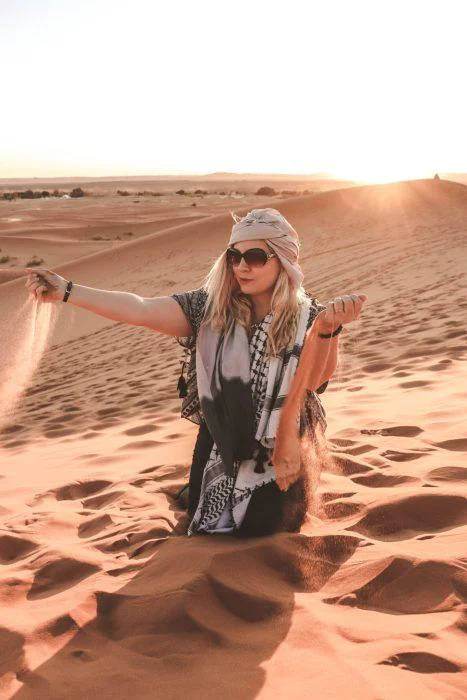
In short: The Amazigh (Berber) people are the indigenous inhabitants of Morocco’s deserts, speaking Tamazight and living across oases, ksour and nomadic camps from the Draa Valley to the Erg Chebbi dunes. Travellers meet this living culture through Ahidous and Gnawa music, mint-tea hospitality, carpet weaving and shared tagine meals under the stars.
Who are the Amazigh (Berber) people?
“Berber” is the older European name; most people today prefer Amazigh (plural Imazighen), meaning “free people.” They are North Africa’s indigenous population, present in Morocco for millennia before the Arab arrival in the 7th century. Roughly a third of Moroccans speak an Amazigh language, and since 2011 Tamazight is an official language written in the Tifinagh script you will see on road signs. In the desert regions you will mainly hear Tashelhit (around the Anti-Atlas and the southern Sahara approaches) alongside other Amazigh dialects. The yellow, green, blue and red Amazigh flag with its central Tifinagh “z” (yaz) symbol appears across the south.
Where do desert Amazigh communities live?
The heartland stretches south and east of the High Atlas. The Draa Valley runs about 200 km from Ouarzazate toward M’Hamid, lined with palm groves and fortified mud villages (ksour). The Dades and Todra gorges shelter Amazigh farming villages, while Merzouga and the Erg Chebbi dunes (roughly 560 km or 9-10 hours from Marrakech) are home to communities with deep nomadic roots. Closer to Marrakech, the Agafay stone desert (about 40 minutes away, and rocky rather than sandy) and the surrounding Atlas foothills are also Amazigh land, making it the easiest place to encounter the culture on a short trip. For the full picture of routes and regions, see our Morocco Desert guide.
What can travellers experience firsthand?
Hospitality is the core value: expect at least three rounds of sweet mint tea, poured from height to build foam. Food centres on tagine, couscous (traditionally on Friday) and bread baked in earth ovens. In desert camps you may hear Ahidous, a communal Amazigh dance with frame drums (bendir) and call-and-response chant, or Gnawa music with its metal krakebs and three-string guembri. Crafts are everywhere: hand-knotted rugs whose diamonds and zigzags encode fertility, protection and tribal identity, plus silver jewellery and leather goods. Buying directly from a village cooperative keeps money local and gives you a genuine story behind the object.
How do you visit respectfully and authentically?
Ask before photographing people, especially women and elders. A few Tashelhit words go far: “azul” (hello) and “tanmirt” (thank you). Dress modestly in villages, covering shoulders and knees. When invited for tea, accept at least one glass. Tip guides, drivers and camp musicians fairly. Choose operators who employ local Amazigh guides and camel handlers rather than staff bussed in from cities. Sleeping in a desert camp, sharing a meal with a nomad family or joining a bread-making session gives far more real contact than a rushed photo stop. Our Morocco Desert guide covers how to pick ethical desert camps.
What does an Amazigh desert experience cost, and when to go?
Treat prices as ranges. A shared standard desert camp near Agafay or Merzouga runs roughly 40-90 EUR per person per night including dinner, breakfast and often a camel ride; luxury tented camps range from about 120 EUR upward. A guided day with a local Amazigh driver-guide is typically 60-120 EUR. A full shared 3-day Merzouga tour is usually around 80-150 EUR per person. The best seasons are spring (March-May) and autumn (September-November), when days are warm and nights mild. Summer (June-August) can pass 45C in the Sahara, though Agafay’s higher elevation stays a little cooler. Winter days are pleasant but desert nights drop near freezing, so pack layers.
Frequently Asked Questions
Is it “Berber” or “Amazigh”? Both refer to the same people. Amazigh is the term the community prefers; “Berber” is still widely used in tourism and is not considered offensive by most, but using “Amazigh” shows respect.
Do desert Amazigh people still live nomadically? A minority still herd goats and camels seasonally, especially around Merzouga and Zagora, but most are now settled in oasis villages while keeping strong nomadic heritage and skills.
What language will I hear in the desert? Mostly Tashelhit and other Amazigh dialects, alongside Moroccan Arabic (Darija). Many guides also speak French, and increasingly English and Spanish.
Can I buy an authentic Amazigh carpet without being overcharged? Yes, but haggle politely and buy from village cooperatives when possible. Prices vary widely, from modest sums for small kilims to several hundred EUR for large hand-knotted wool rugs.
Is Agafay a good place to meet Amazigh culture on a short trip? Absolutely. This stone desert is only about 40 minutes (30-40 km) from Marrakech, so you can experience Amazigh hospitality, music and camp life on an overnight or even a sunset dinner.
👉 Planning your trip? Ask our local agency on WhatsApp
Planning your trip? Explore our Morocco desert tours from Marrakech, 3-day Marrakech to Merzouga tour and 2-day Zagora tour.