
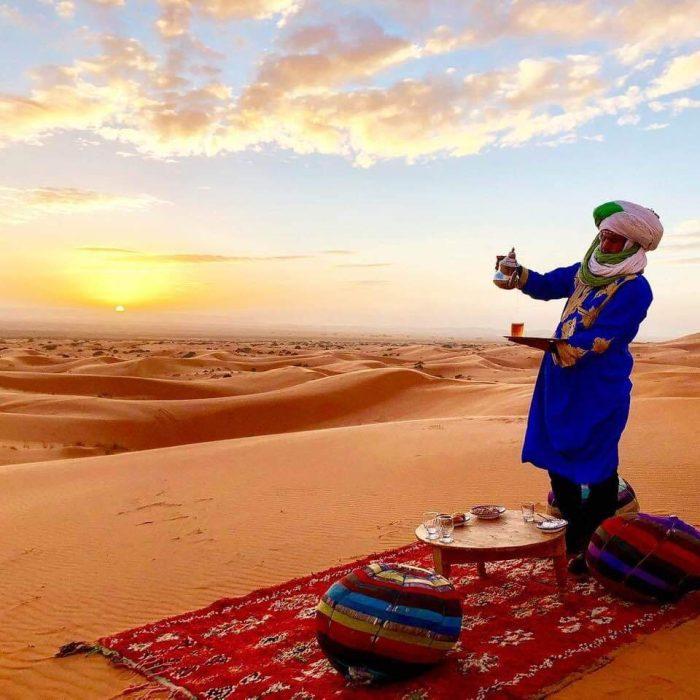
In short: Sahara stargazing in Morocco is best from the dune fields around Merzouga (Erg Chebbi) and M’Hamid/Erg Chigaga, where near-zero light pollution and dry desert air reveal the Milky Way with the naked eye. Most travelers combine it with an overnight camel trek and a night in a desert camp, ideally from roughly April to early June and September to November, around the new moon.
Planning a desert trip? See all private Morocco desert tours from Marrakech.
Why is the Moroccan Sahara so good for stargazing?
The deep desert sits far from any city glow. Merzouga is about 560 km southeast of Marrakech (a 9-10 hour drive, usually done as a 3-day tour) and Erg Chigaga is reached via M’Hamid, several kilometres of off-road track beyond the last village. Out here the sky is exceptionally dark — on a moonless night the Milky Way is bright enough to cast the faintest shadow, and thousands of stars are visible with no equipment at all. The dry pre-Saharan air, low humidity and stable atmosphere cut the shimmer that blurs stars elsewhere, so even planets like Jupiter and Saturn look crisp through a modest telescope. Winter nights are the longest and clearest, though also the coldest.
Where are the best stargazing spots?
Erg Chebbi near Merzouga is the most accessible: paved road access, dozens of camps, and dunes rising to about 150 m that wall off any distant horizon light. Erg Chigaga, deeper and wilder, needs a 4×4 and gives even darker skies with almost no other camps nearby. The stony Agafay Desert, only about 40 minutes from Marrakech, is a popular one-night option but sits close enough to the city to catch some light bleed, so it suits casual sky-watching rather than serious astronomy. For a full overview of each region, see our Morocco Desert guide.
What does a stargazing tour include?
A typical desert night starts with a camel trek into the dunes at sunset, then dinner of tagine and bread around a low table, and often some Berber drumming before the sky fully darkens. Better tours include a guide who points out constellations, or a camp with a telescope for viewing lunar craters, Saturn’s rings and star clusters. A few specialist camps near Merzouga run dedicated astronomy nights with laser-pointer sky tours and basic astrophotography help. The single most useful thing you can pack is a headlamp with a red-light mode — white light wrecks the night vision it takes 20-30 minutes to build.
How much does it cost and how long does it take?
A standard overnight desert camp with camel ride, dinner and breakfast runs roughly 25-60 EUR per person in a shared camp near Merzouga. Luxury or “astronomy” camps with private tents and telescopes range from about 90-200 EUR per person. A 3-day round trip from Marrakech to Merzouga with a night in the dunes typically costs about 80-150 EUR per person in a shared group. Agafay overnights, being closer, sit around 60-120 EUR. Always confirm whether transport, dinner and the camel trek are included before you book.
When is the best time for Sahara stargazing?
The clearest, most comfortable skies come in spring (April to early June) and autumn (September to November), with mild nights and only a small chance of a passing sandstorm. Winter (December to February) delivers the darkest, longest nights and the sharpest transparency, but temperatures can fall near freezing after midnight, so pack real layers. Summer nights are short and daytime heat can top 45 C. For the brightest Milky Way core, aim for the new-moon window each month, when there is no moonlight to wash out fainter stars. Our Morocco Desert guide covers seasonal packing in more detail.
Frequently Asked Questions
Can I see the Milky Way with the naked eye? Yes. On a moonless night in Erg Chebbi or Erg Chigaga the Milky Way is clearly visible as a bright band, along with major constellations, star clusters and frequent shooting stars.
Do I need a telescope? No. The naked-eye sky is spectacular, but a telescope adds detail on the Moon, Saturn and Jupiter. Some camps supply one; binoculars also work well for sweeping the Milky Way.
How cold does it get at night? Spring and autumn nights are mild (around 10-15 C), but winter can drop close to 0 C after midnight. Camps provide heavy blankets; bring a warm jacket, hat and closed shoes.
Is it safe to travel to the desert camps? Yes. The Merzouga and M’Hamid regions are well-established tourist areas with licensed camps and guides. Book through a reputable local operator and confirm the transfer arrangements.
How far in advance should I book? For new-moon dates in high season (spring and autumn), book two to four weeks ahead, as the darkest-sky nights and telescope camps fill quickly.
👉 Planning your trip? Ask our local agency on WhatsApp.