
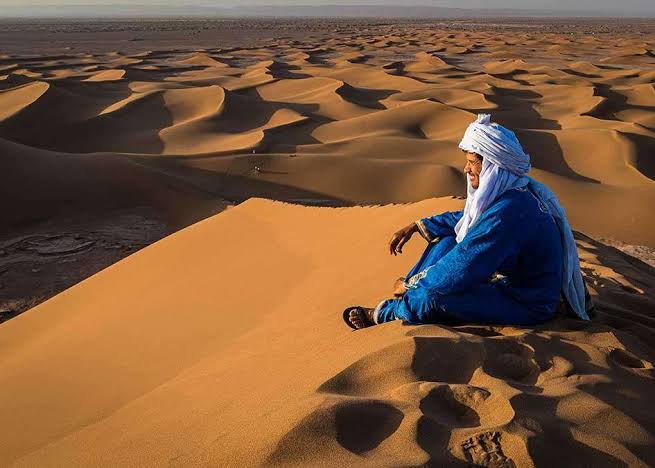
In short: A night in a Sahara desert camp near Merzouga (Erg Chebbi) or M’Hamid (Erg Chigaga) typically includes a sunset camel trek into the dunes, a hot dinner served in a communal tent, live Berber drumming around the fire, a bed in a private canvas tent, and a pre-dawn wake-up for sunrise. Most travelers arrive on a 3-day tour from Marrakech (~560km, 9-10h of driving spread over two days).
Comparing camps? See all our Agafay desert camps, how to choose the right camp and the Agafay day pass guide.
Where does the desert night actually happen?
The classic “big dune” experience is at Erg Chebbi, the sea of orange dunes beside Merzouga, where the tallest crests reach roughly 150m. From Marrakech it is about 560km and 9-10 hours of driving, which is why nobody does it in a day, the standard format is a 3-day, 2-night loop with an overnight in the dunes. Coming from Fes it is shorter, around 470km and 7-8 hours. The other true Sahara option is Erg Chigaga near M’Hamid, more remote and reached only by 4×4 over rough piste, so it feels wilder and far less crowded. If you only have time for a 2-day trip, Zagora (~360km, ~7h from Marrakech) is the usual compromise, though its dunes are modest. Note that Agafay, the “desert” just 40 minutes from Marrakech, is a rocky stone plateau, not sand dunes, it is a lovely quick escape but it is not the Sahara.
How do you get from the road to the camp?
Vehicles can’t cross deep sand, so the last stretch is on foot or, more memorably, by camel. Most camps line up dromedaries in the late afternoon and lead you in a slow caravan over the crests as the light turns gold, a ride of roughly 45 minutes to an hour and a half depending on how far into the erg your camp sits. Bring a scarf, the guides show you how to wrap it against blowing sand, and wear closed shoes because sand gets everywhere. Some operators offer a 4×4 transfer instead if you’d rather skip the saddle. Either way you usually reach camp right around sunset, which is deliberate, watching the dunes shift from copper to violet is the whole point.
What is inside the camp itself?
Camps range from simple to genuinely luxurious. A standard setup gives you a private walk-in canvas tent with real beds, blankets, and often a rug-covered floor, clustered around a central dining tent and a fire pit. Shared toilets and cold or solar-heated showers are common in mid-range camps, while upscale “glamping” tents come with en-suite bathrooms, proper linens, and even a small terrace. Electricity is usually limited to a few hours from a generator or solar panels, so charge your phone before you leave and don’t expect Wi-Fi. Dinner is typically a tagine or couscous with bread, soup, and fruit, cooked on site and served communally, tea flows constantly. After dark the staff often bring out drums for an hour of Gnawa and Berber rhythms, and because there is zero light pollution, the stargazing is extraordinary, on a clear night you can trace the Milky Way with the naked eye.
What does a night in the dunes cost?
Prices vary enormously with comfort level and group size. A shared 3-day Merzouga tour from Marrakech, including transport, one or two nights, and meals at the camp, commonly runs in the region of 80-150 EUR per person. Private tours and luxury camps with en-suite tents cost considerably more, while a bare-bones 2-day Zagora trip sits at the lower end. What is almost always included: transport, camel trek, dinner, breakfast, and the tent. What is often extra: lunches on the road, drinks, tips for guides and drivers, and any activities like sandboarding or a longer camel ride. Always confirm exactly which nights and meals are covered before you book, the cheapest quote sometimes hides a fuel or camp surcharge.
When should you go, and what should you pack?
The comfortable window is October to April. Summer daytime highs blow past 40C and make midday in the sand punishing, while winter delivers warm, clear days but genuinely cold nights, the desert loses heat fast once the sun drops, so temperatures near freezing are normal in December and January. Pack layers: light clothing for the day, a warm jacket, hat, and even gloves for the evening, plus sunscreen, sunglasses, and lip balm year-round. A headlamp is handy for finding your tent, and a refillable water bottle saves plastic. Sturdy closed shoes beat sandals for the camel and the dune walk. For the full route planning, our Morocco Desert guide breaks down the itineraries in detail.
Frequently Asked Questions
Is a night in a desert camp safe? Yes. Reputable camps are staffed overnight, the camel treks are led by experienced guides, and thousands of travelers do it every season without issue. Book through an established operator and follow your guide’s advice on the dunes.
Do I have to ride a camel to reach the camp? Not always. The camel caravan is the traditional and most scenic arrival, but many operators offer a 4×4 transfer to the tents instead if you have mobility concerns or simply prefer it.
Is there a bathroom and shower? Mid-range camps usually have shared toilets and showers, and luxury camps offer private en-suite tents. Confirm the exact facilities with your operator, as basic camps can be quite spartan.
Will I have phone signal or Wi-Fi? Rarely. Mobile coverage in the deep dunes is patchy to nonexistent and Wi-Fi is uncommon. Treat the night as a genuine disconnect, and download maps or music in advance.
Can I visit the real Sahara in one day from Marrakech? No. The nearest true dunes at Merzouga are 9-10 hours each way, so an overnight is essential. For a same-day taste of open desert, Agafay’s rocky plateau is 40 minutes out, but it has no sand dunes. See our related guide for a full comparison.
👉 Planning your trip? Ask our local agency on WhatsApp.