
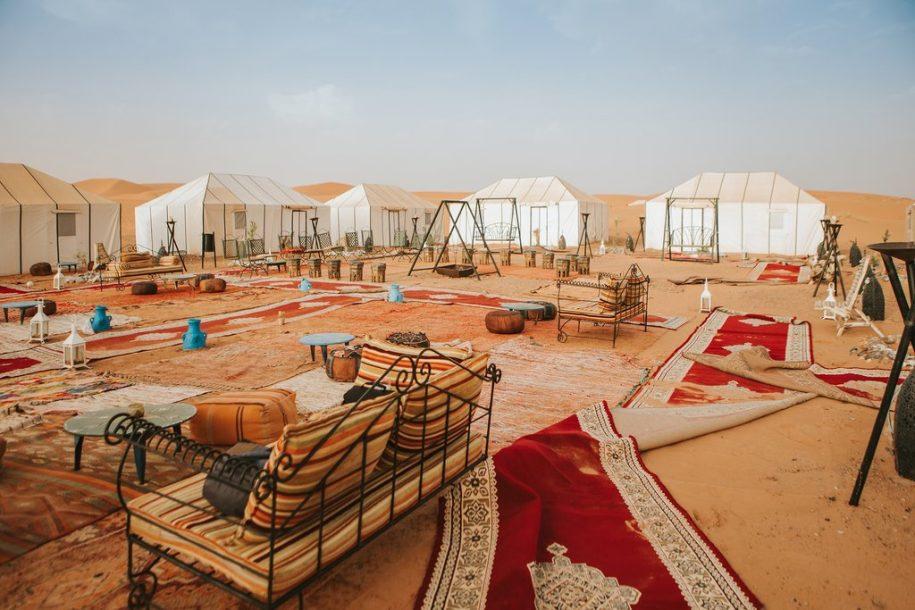
In short: Yes, you can visit the Morocco desert in July, but daytime highs regularly top 40°C at Merzouga and Zagora, so you plan around the heat rather than fighting it. Travel at dawn and dusk, keep midday for shade and pools, and expect quieter camps and softer prices than in the October–April high season.
Is July too hot for the Morocco desert?
July is the hottest stretch of the year in the Sahara. At Erg Chebbi near Merzouga and in the Draa Valley around Zagora, afternoon temperatures sit comfortably above 40°C, and the sand itself becomes untouchable by mid-afternoon. This is the opposite of the ideal window: the best season to visit runs October to April, when days are mild and nights are pleasant. That said, July is not off-limits. The heat is dry rather than humid, evenings cool down noticeably once the sun drops behind the dunes, and the desert nights in summer stay warm and comfortable instead of the near-freezing cold you get on winter nights. If you accept a slower rhythm, a July trip absolutely works.
How the heat changes your day (and itinerary)
The single biggest adjustment is timing. On my summer runs out here, everything worthwhile happens before 9am or after 6pm. You ride camels or walk the dunes at sunrise, retreat to shade or a pool by late morning, and come back out for sunset and the star-filled night. Midday is for doing nothing productive on purpose.
Driving distances matter more in July because you want to avoid long afternoon stretches in a hot vehicle. From Marrakech, Merzouga is roughly 560km and 9–10 hours, so the classic 3-day tour over the Atlas and Todra Gorge is far more bearable than any rushed attempt. From Fes, Merzouga is about 470km and 7–8 hours. If you want less driving, Zagora is closer at around 360km and about 7 hours from Marrakech, making a 2-day trip realistic. Break the drive, hydrate constantly, and start early each morning.
Merzouga, Zagora, or Agafay in summer?
For the iconic tall dunes, Erg Chebbi at Merzouga is the headline: golden sand seas rising to roughly 150m. It is the postcard Sahara and worth the long haul. Erg Chigaga, the more remote dune field reached by 4×4 from M’Hamid, is wilder and emptier but harder to reach in the heat, so it suits travelers who genuinely want isolation.
Agafay is a different animal entirely. It is a rocky, stone desert about 40 minutes from Marrakech, not a dune landscape. In July, Agafay is the pragmatic choice for anyone short on time or unwilling to spend two days driving in high heat: you get desert scenery, camps, and Atlas views without the eight-hour transfer. Just set expectations, no golden dunes there. For the full picture, see our Morocco Desert guide.
What does a July desert tour cost?
Summer is low season for the deep desert, which usually means better availability and softer rates. A shared 3-day Merzouga tour from Marrakech typically runs around 80–150 EUR per person, covering transport, a night in a desert camp, and often breakfast and dinner. Private tours and higher-end camps cost more; budget shared groups sit at the lower end. Prices swing with group size, camp standard, and how much you negotiate, so treat these as ranges rather than fixed figures. Because July draws fewer crowds, you can often find room without booking months ahead, though the best camps still fill for weekends.
Packing and staying safe in the heat
Pack for extremes in both directions. Bring far more water than feels reasonable, loose light-colored long sleeves that block the sun better than bare skin, a wide brimmed hat, high-SPF sunscreen, and a scarf or chesh to wrap against blowing sand. Sunglasses and electrolyte sachets earn their place. Despite the daytime furnace, a light layer for evenings is worth carrying because the temperature genuinely drops after dark. Watch for heat exhaustion signs, dizziness, headache, and stopping sweating, and never push a midday dune climb. Our related guide covers logistics in more depth.
Frequently Asked Questions
How hot does the Morocco desert get in July? Daytime highs at Merzouga and Zagora routinely exceed 40°C, with the sand hotter still, while nights stay warm and comfortable rather than cold.
Is it worth doing a desert tour in July? Yes, if you plan around the heat, travel at dawn and dusk, and accept a slower pace. You trade peak comfort for fewer crowds and better availability.
Which is better in summer, Merzouga or Agafay? Merzouga has the tall 150m dunes but needs a long drive; Agafay is a rocky desert just 40 minutes from Marrakech and far easier in the heat, though without dunes.
How much does a July desert trip cost? A shared 3-day Merzouga tour from Marrakech generally runs about 80–150 EUR per person, varying with group size and camp standard.
When is the best time to visit instead? October to April offers mild days and cool nights and is the ideal season if your dates are flexible.
👉 Planning your trip? Ask our local agency on WhatsApp.
Planning your trip? Explore our Morocco desert tours from Marrakech, 3-day Marrakech to Merzouga tour and 2-day Zagora tour.