
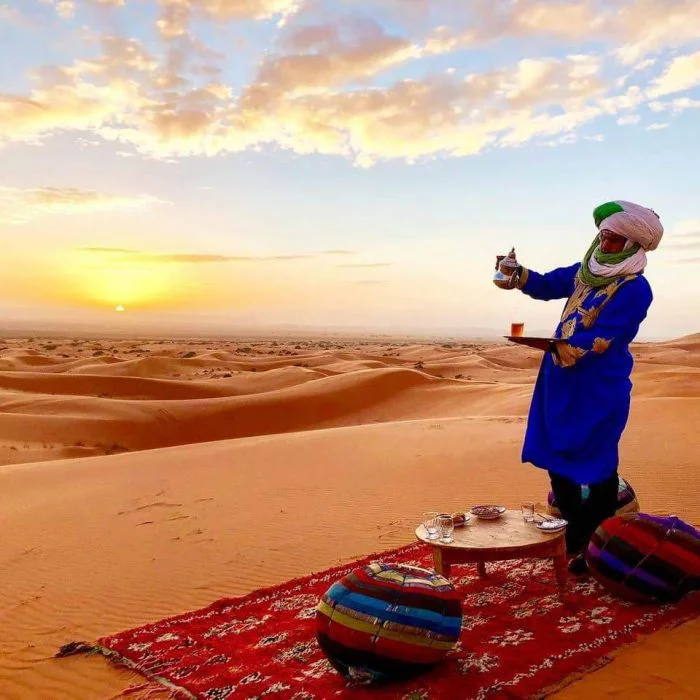
In short: Tipping on a Morocco desert tour is customary but modest: plan roughly 100–200 MAD (about 10–20 EUR) per traveller per day, split between your driver, camp staff and camel handlers. Hand tips discreetly in cash (dirhams), and pair them with simple courtesies — removing your shoes in a tent, accepting the mint tea, asking before you photograph anyone.
How much should you tip on a Morocco desert tour?
There is no fixed rule, but locals and guides work on a “small and sincere” logic. As a rough guide per traveller: a private driver on a multi-day loop, around 100–150 MAD (10–15 EUR) per day; a dedicated desert guide or cook, 50–100 MAD per day; camel handlers who lead you over the dunes, 20–50 MAD each; and camp staff, pooled at 50–100 MAD per night. On a classic 3-day Marrakech–Erg Chebbi trip (roughly 560 km and 9–10 hours of driving each way, spread across the days), a couple usually ends up tipping around 400–700 MAD in total. On a short overnight in the rocky Agafay desert, just 40 minutes from Marrakech, 100–200 MAD split among the small team is plenty.
Who do you actually tip, and when?
A desert trip involves several people, and each owns a distinct piece of your experience. Your driver-guide is usually the anchor of the whole trip; tip them once at the very end, not daily, so the gesture reflects the entire journey. Camp cooks and staff are best tipped the morning you leave — hand it to one senior person to share fairly, or drop it in the communal tip box if the camp has one. Camel handlers should be tipped directly at the end of the dune ride, as they are often day workers who do not see the rest of your itinerary and will not cross your path again. If a musician plays around the fire, or someone hauls heavy bags up the sand for you, a small 10–20 MAD note is a warm touch.
Cash, currency and small notes
Tip in Moroccan dirhams, not euros or dollars — rural staff cannot easily change foreign coins, and coins from abroad are effectively worthless to them. Withdraw cash in Marrakech or Ouarzazate before you head into the desert, because ATMs thin out fast past the last towns and there is nothing usable out at the dunes. Ask the machine or a shop for small denominations: 20, 50 and 100 MAD notes make discreet, fair tipping far easier than breaking one big bill. Keep your tip money in a separate pocket from your main wallet, so you are not fanning a thick stack of cash in front of people earning a modest daily wage. For deeper planning, see our Morocco Desert guide.
Private Morocco desert tours from Marrakech
Our private desert circuits leave from Marrakech with your own driver: 3 days to Merzouga from 385€ per person, 4 days to Erg Chigaga from 560€ per person.
Desert etiquette beyond tipping
Money is only part of good manners in the Sahara. Dress modestly — shoulders and knees covered — especially passing through Berber villages in the Draa and Ziz valleys on the drive. Always ask before photographing people, particularly women and nomadic families; a smile and a nod toward your camera is enough, and “no” means no. Remove your shoes before stepping onto the carpets inside a tent, and accept the ritual glass of mint tea when it is offered — refusing outright can feel cold. Eat from the shared tagine or couscous with your right hand, and try not to waste food or water, both of which are hauled in at real cost across long distances to reach a desert camp.
Cultural moments where etiquette matters most
Certain touchpoints reward extra sensitivity. During Ramadan, avoid eating, drinking or smoking openly in front of hosts who are fasting from dawn to dusk. When you bargain for a scarf or a fossil, keep it friendly and light-hearted; haggling is expected, but hard-edged aggression is not. If you are invited into a family home or a nomad tent, a small gift of tea, sugar or nuts is a gracious touch rather than an expectation. Greet people with “Salam” and a hand over the heart, and learn a couple of words — “shukran” (thank you) goes a long way. These habits, more than any tip, are what leave hosts genuinely glad you came, as our Morocco Desert guide also underlines.
Frequently Asked Questions
Is tipping mandatory in the Morocco desert? No, it is not legally required, but it is a strong social custom and a meaningful part of income for drivers, cooks and camel handlers who often earn modest daily wages.
Can I tip in euros instead of dirhams? It is far better to tip in dirhams. Rural desert staff cannot easily exchange euro coins or small notes, so foreign currency often becomes useless to them.
Do I tip the driver every day or at the end? Tip a multi-day driver-guide once, at the end of the trip, so the amount reflects the whole journey. Camp staff and camel handlers are tipped as you leave each place.
How much should I tip a camel handler? Around 20–50 MAD (2–5 EUR) per handler at the end of the dune ride is standard, handed to them directly rather than pooled with the camp.
Should I bring a gift instead of money? Gifts like tea, sugar or nuts are appreciated if you are welcomed into a home or nomad tent, but they complement rather than replace a cash tip for the working team.
👉 Planning your trip? Ask our local agency on WhatsApp.
Planning your trip? Explore our 3-day Marrakech to Merzouga tour and 2-day Zagora tour.