
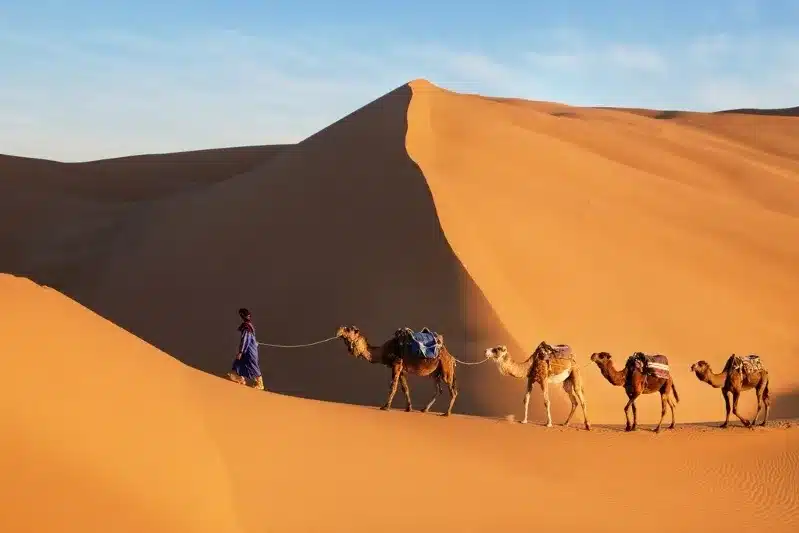
In short: Morocco’s desert can absolutely be experienced with a wheelchair or limited mobility, but it takes planning: the deep sand at Erg Chebbi (Merzouga) and Erg Chigaga is the real obstacle, not the drive. The rocky Agafay Desert, just 40 minutes from Marrakech, is by far the easiest terrain, while the long Sahara routes reward those willing to organise the right vehicle and support.
Planning a desert trip? See our Agafay Desert guide.
Is the Morocco desert wheelchair-friendly at all?
Let’s be honest first: Morocco was not built with step-free access in mind. Medinas have cobbles, kasbahs have stairs, and the classic dune fields are soft sand where standard wheelchairs sink instantly. But “the desert” is not one place. On my own trips the difference between a frustrating day and a magical one came down to matching the terrain to your mobility. Rocky, flat desert (hamada) and the edges of the dunes are manageable with help; the towering sand itself needs beach-style wheels or a strong team. Go in expecting to plan, not to improvise, and Morocco opens up more than most people assume.
Which desert is easiest: Agafay or the Sahara?
If mobility is a concern, start with Agafay. It’s a rocky, stony desert about 40 minutes from Marrakech, so there’s no long transfer and, crucially, no deep dunes to cross. The ground is firm and rolling, camps sit close to the parking, and you can enjoy sunset, dinner, and star-filled skies without a full expedition. It is not the golden-dune postcard, but for a first taste with a wheelchair it’s the sensible choice. For the true Sahara you’re looking at Erg Chebbi near Merzouga, where the tallest dunes reach roughly 150 metres, or the remote Erg Chigaga near M’Hamid, reached only by 4×4 over rough tracks. Both are stunning and both demand more support.
How long is the drive, and can I break it up?
Distance is the hidden accessibility issue. Marrakech to Merzouga is around 560 km, a 9-10 hour drive normally sold as a 3-day tour, which is exactly what you want: it splits the journey with overnight stops so you’re not trapped in a vehicle all day. Fes to Merzouga is shorter at roughly 470 km and 7-8 hours. If even that feels long, the Marrakech to Zagora route is about 360 km and around 7 hours, usually a 2-day trip. For anyone with pressure-sore risk or limited sitting tolerance, choose the multi-day option and ask the operator to build in regular stops, a supportive front seat, and cushions. Read our Morocco Desert guide to compare each route in detail.
What about camels, camps, and the dunes themselves?
The camel trek into camp is the part most wheelchair travellers can’t do in the standard way, since mounting and the swaying ride are difficult and unsupported. The good news: many camps near Merzouga are now reachable by 4×4 directly to the tents, bypassing the camel entirely. Ask specifically for a “vehicle access to camp” arrangement rather than assuming it. Firm-ground viewpoints let you watch sunrise over the dunes without crossing them, and a companion or two can help push a wheelchair over the packed sand at the dune base. For sand itself, balloon-tyre or beach wheelchairs make a huge difference, but you’ll usually need to bring or pre-arrange one.
When should I go for comfort and safety?
Timing matters more when heat and cold both raise real health risks. The best season is October to April, when days are pleasant and the light is gorgeous. Avoid summer, when the Sahara routinely tops 40C and long transfers become genuinely dangerous for anyone with limited mobility or temperature-regulation issues. Winter days are lovely but desert nights get properly cold, so pack layers for the camp. Shoulder months like October, March, and April tend to hit the sweet spot: warm enough for evenings out, cool enough for the drive. See our related guide for a month-by-month breakdown.
What does it cost and how do I book right?
Shared 3-day Merzouga tours typically run around 80-150 EUR per person, but for accessible travel a private tour is usually worth it: you control the pace, the stops, and the vehicle. Prices vary widely with group size, vehicle type, and camp standard, so ask for a written quote rather than trusting a headline figure. Above all, be specific when you enquire, spell out your exact needs, whether you can transfer from the chair, and any medical considerations, so the operator can arrange the right 4×4 and support.
Frequently Asked Questions
Can a manual wheelchair handle the Sahara dunes? Not the soft dunes themselves, they sink. Firm hamada ground and dune bases are manageable with help, and beach-style wheels transform what’s possible.
Is Agafay a good alternative to Merzouga? Yes, for accessibility it’s the easiest: rocky flat ground, only 40 minutes from Marrakech, no dunes to cross, and camps close to the parking.
Do I have to ride a camel to reach a desert camp? No. Many Merzouga-area camps can be reached by 4×4 straight to the tents, request this explicitly when booking.
When is the safest time to travel with limited mobility? October to April. Skip summer, when Sahara heat tops 40C, and pack warm layers for cold winter nights.
Should I book a shared or private accessible tour? Private is strongly recommended, you control the pace, stops, and vehicle, which shared tours can’t guarantee.
👉 Planning your trip? Ask our local agency on WhatsApp.
Planning your trip? Explore our Morocco desert tours from Marrakech and 2-day Zagora tour.