
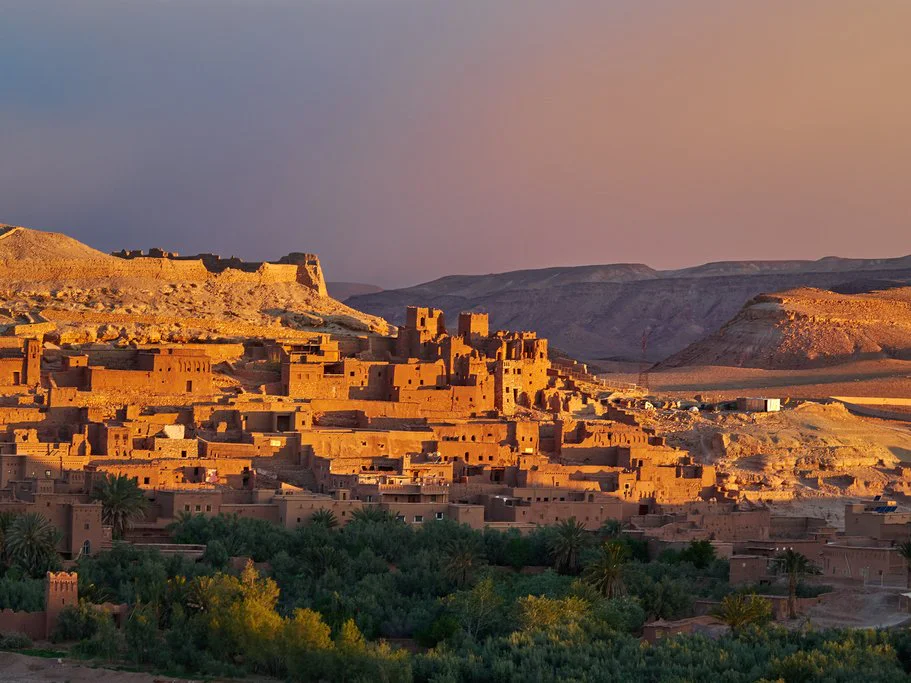
In short: The Jebel Saghro trek crosses a stark volcanic massif between the High Atlas and the Sahara, offering rocky gorges, black basalt spires and Berber nomad camps rather than sand dunes. It is Morocco’s premier winter trek (Nov-Mar), when the high peaks are snowbound and Saghro stays walkable at 1,600-2,700m.
Want to explore beyond Marrakech? See Ait Bouguemez valley trek from Marrakech or private day trips from Marrakech.
Where is Jebel Saghro and what makes it different?
Jebel Saghro is a rugged anti-Atlas range in southeastern Morocco, roughly between Ouarzazate to the west and the palm valleys of the Draa and Dades to the south. It is not a sand desert like Erg Chebbi near Merzouga or the remote dunes of Erg Chigaga near M’Hamid. Instead you get a “stone desert” landscape of eroded plateaus, volcanic plugs and dry riverbeds, closer in spirit to the rocky Agafay desert 40 minutes from Marrakech, but far wilder and at real altitude. The trailheads sit within reach of the N10 road that links Ouarzazate to Errachidia, so many trekkers combine Saghro with a wider desert circuit toward Merzouga.
Why trek Saghro in winter?
This is the key selling point. When the High Atlas around Toubkal is deep in snow from roughly December to March, Jebel Saghro stays trekkable because its ridges are lower and drier. Days are cool and clear, ideal for walking, though nights drop below freezing at altitude, so a proper sleeping bag rated to at least -5C is essential. Summer is brutal here, with daytime heat well over 40C on the exposed plateaus, so almost nobody treks June to August. The sweet window mirrors the wider desert season of October to April, but Saghro specifically shines in the cold months when other Moroccan mountain routes are closed.
What does a typical Saghro trek look like?
Most guided treks run 3 to 6 days, starting near villages such as Tagdilt or N’Kob and finishing toward the Dades side. The classic sight is Bab n’Ali, a cluster of dramatic rock towers rising from the valley floor, usually reached on the second day. You walk between 5 and 7 hours daily across passes around 2,300-2,700m, sleeping in tents or simple stone gites. Mules carry the heavy gear, and you often share tea with Aït Atta nomads who still move their goat herds seasonally through these mountains. The terrain is stony underfoot, so decent boots matter more than on softer desert routes.
How do I get there and combine it with the dunes?
Saghro pairs naturally with a Sahara trip. From Marrakech the drive toward Merzouga is roughly 560km and 9-10 hours, usually split as a 3-day tour, so a common plan is to trek Saghro first, then continue east to the tall dunes of Erg Chebbi (around 150m high) at Merzouga. From Fes, Merzouga is closer at about 470km and 7-8 hours. If your time is short, the Marrakech-Zagora route is only about 360km and roughly 7 hours as a 2-day loop, and Zagora is your gateway toward Ouarzazate and the Saghro trailheads. For deeper planning see our Morocco Desert guide.
What should I budget and pack?
A guided Saghro trek is priced per day and typically includes a licensed mountain guide, mules, cook and camping gear; it is not the same product as a cheap shared Sahara minibus tour. For comparison, a shared 3-day Merzouga tour runs roughly 80-150 EUR per person, while a private multi-day mountain trek with full support costs more per day because of the crew involved. Always confirm exactly what is included before booking. Pack layers for a 20C swing between midday sun and freezing dawn, a warm sleeping bag, sturdy boots, sun protection and more water capacity than you think, since springs are scarce on the plateaus. Our related guide covers seasonal packing in more detail.
Frequently Asked Questions
Is Jebel Saghro a sand-dune desert? No. It is a rocky volcanic mountain desert. For real dunes you want Erg Chebbi at Merzouga or Erg Chigaga near M’Hamid, both several hours further southeast.
When is the best time to trek Saghro? November to March. It is the classic winter alternative when the High Atlas is snowbound. Avoid summer, when temperatures top 40C.
How many days do I need? Most treks run 3 to 6 days. A 3-day route reaches the Bab n’Ali rock towers, the range’s signature landmark.
Do I need a guide? Yes. Routes are unmarked, water is scarce and navigation is genuinely hard, so a licensed local guide with mule support is strongly recommended.
Can I combine Saghro with Merzouga? Yes. Many travelers trek Saghro then drive east to Erg Chebbi at Merzouga to finish with a night on the tall Sahara dunes.
👉 Planning your trip? Ask our local agency on WhatsApp.
Planning your trip? Explore our Morocco desert tours from Marrakech, 3-day Marrakech to Merzouga tour and 2-day Zagora tour.