
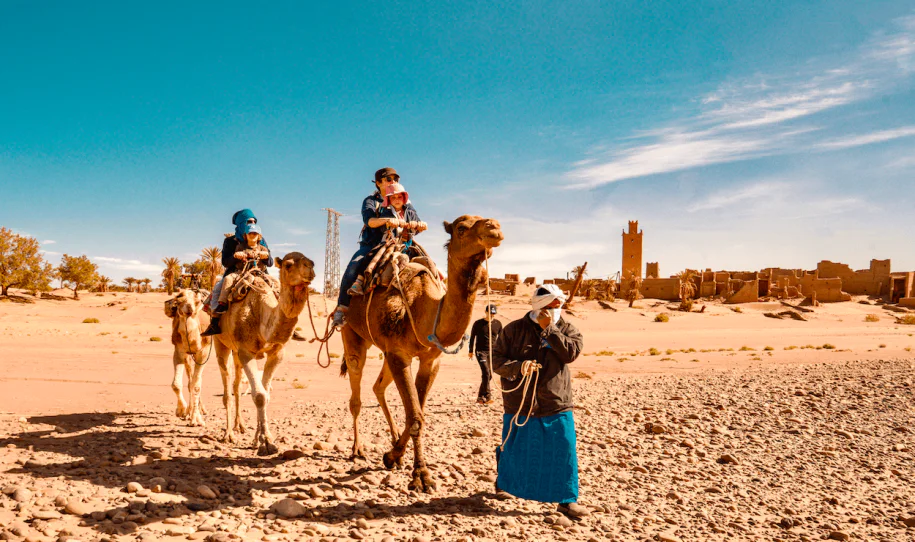
In short: The Draa Valley is Morocco’s longest palm oasis, a roughly 200 km ribbon of date groves, mud-brick kasbahs and Berber villages running south from Ouarzazate through Agdz and Zagora toward the Sahara. It is the classic scenic road travelers drive on a 2 or 3 day desert tour to reach M’Hamid and the Erg Chigaga dunes.
Where is the Draa Valley and how do you get there?
The Draa (also spelled Draa or Dra) begins near Ouarzazate, at the foot of the High Atlas, and follows the Draa River south through Agdz, Tamnougalt, Timiderte, Tinzouline and Zagora before fading into the desert at M’Hamid El Ghizlane. From Marrakech, the drive to Ouarzazate is about 200 km (roughly 4 hours) over the Tizi n’Tichka pass (2,260 m); from Ouarzazate to Zagora is another 165 km (about 2.5 to 3 hours) via the Tizi n’Tinififft pass, so Marrakech to Zagora totals around 360 km and about 7 hours. Most people cover it as part of a 2 or 3 day tour, but self-driving a normal car is easy on the paved N9. Fill the tank in Ouarzazate or Agdz, as stations thin out south of Zagora. This region is a natural extension of the southern circuit covered in our Morocco Desert guide.
What makes the palm groves special?
The valley holds roughly two million date palms and produces some of Morocco’s finest dates, harvested in October. Prized varieties like jihel and the sweet boufeggous fill the roadside souks at harvest time, and a kilo bought straight from a farmer costs a fraction of the Marrakech price. Between the palms, families still grow henna, alfalfa, barley and vegetables in a layered oasis system fed by the river and old khettara channels. Walking a few hundred meters into a palmeraie, especially near Agdz or Tamnougalt, is the single best way to understand how life works here: dense shade, running water and thick pise walls that keep interiors cool through 40 C summers.
Which kasbahs and villages should you stop at?
The Draa is lined with earthen kasbahs and fortified ksour. Kasbah Tamnougalt, just past Agdz, is one of the oldest and most atmospheric, once the seat of the region’s tribal court; entry is a couple of euros and a resident guide will walk you through the old caid’s quarters. Nearby Timiderte kasbah is linked to the Glaoui family. Further south, Tinzouline holds a lively Monday souk, and the pre-Saharan town of Zagora is famous for its painted “Timbuktu 52 days by camel” sign. Give yourself time to actually stop; the valley rewards a slow drive far more than a fast one.
How does the Draa connect to the Sahara dunes?
Zagora is not the end of the road. Continue about 98 km south (roughly 1.5 hours) to M’Hamid El Ghizlane, the last village before the open desert and the gateway to Erg Chigaga, the region’s largest and most remote dune sea. Reaching Chigaga requires a 2 to 3 hour 4×4 transfer, or a multi-day camel trek, across some 60 km of stony hamada, which keeps the crowds away. Zagora’s own smaller dunes, Tinfou and Erg Lehoudi, are closer and easier if you only have one night. A shared overnight desert camp with dinner, breakfast and a short camel ride runs roughly 40 to 90 EUR per person depending on comfort level.
When is the best time to visit?
The best season is October to April. Autumn (October to November) and spring (March to April) are ideal: warm days, cool nights, and in October the date harvest. Winter brings pleasant daytime temperatures but genuinely cold desert nights, sometimes near freezing, so pack a warm layer even for a single night in a camp. Summer (June to August) is harsh, with valley temperatures often above 40 C, though camps stay open for the star-filled skies. Whenever you go, drive the Draa in daylight so you actually see the palms, kasbahs and river bends that make the road worthwhile.
Frequently Asked Questions
How long is the Draa Valley? The palm-grove stretch runs about 200 km from Agdz to M’Hamid, while the full Draa River, Morocco’s longest, extends much further toward the Atlantic before drying up in the sands.
Can I drive the Draa Valley in a regular car? Yes. The N9 from Ouarzazate through Zagora to M’Hamid is fully paved and fine for any car. Only the final push into Erg Chigaga needs a 4×4.
How many days do I need? A 2-day, 1-night trip covers Marrakech to a Zagora-area camp and back. To reach Erg Chigaga and explore properly, plan 3 days and 2 nights.
Is the Draa worth it compared to Merzouga? Yes, for different reasons. The Draa offers oases, kasbahs and a quieter road toward Erg Chigaga; Merzouga (about 560 km and 9 to 10 hours from Marrakech, usually a 3-day tour) has the tallest golden dunes, Erg Chebbi. Many travelers pick the Draa as the less touristy alternative.
What should I buy in the valley? Local dates in autumn, henna, and handwoven textiles or pottery from village souks like Tinzouline and Zagora.
👉 Planning your trip? Ask our local agency on WhatsApp.
Continuing down the valley? This Zagora travel guide picks up where the Draa’s palms end and the dunes begin.
Planning your trip? Explore our Morocco desert tours from Marrakech, 3-day Marrakech to Merzouga tour and 2-day Zagora tour.