
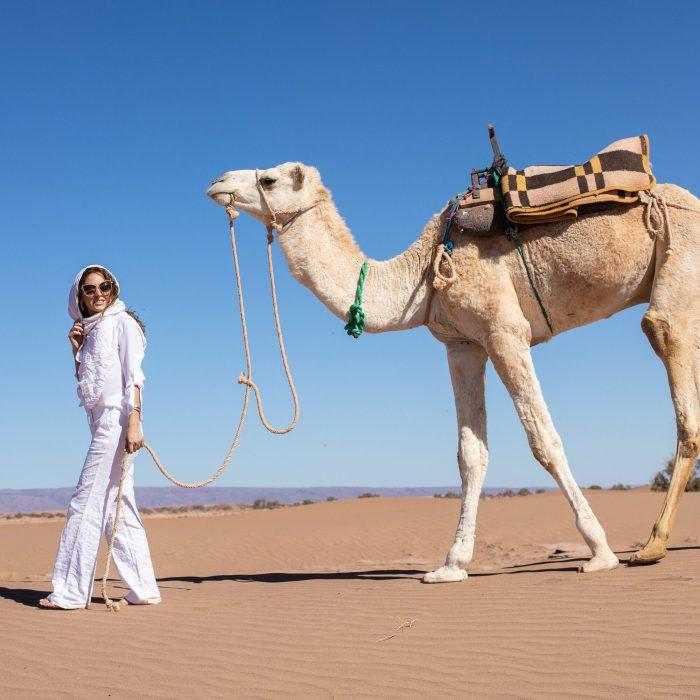
In short: For a Morocco Sahara trip, pack layers for a 15–20°C day-to-night swing, closed shoes plus sandals, a scarf and sunglasses against the fine sand, high-SPF sunscreen, a power bank, and a light jacket even in summer. The camp handles food, water and bedding, so travel light with a soft duffel or backpack rather than a hard suitcase. Get this right and the desert leg of your tour is pure comfort.
What are the absolute essentials?
The dunes around Merzouga (Erg Chebbi, Morocco’s tallest dunes at up to about 150 m) and M’Hamid (Erg Chigaga, reached only by 4×4) are genuinely remote, so bring what you cannot buy once you leave the last town. Your core list: a wide-brimmed hat or a cotton scarf (a local cheche is cheap in Merzouga and locals will happily wrap it for you), high-SPF sunscreen and lip balm, sunglasses with real UV protection, a refillable 1–1.5L water bottle, and a headlamp or small torch for moving around camp after dark. Add a power bank: many desert camps run on solar and cut the generator late in the evening, so charging is limited. Carry cash in dirhams too — there are no ATMs at the dunes, and tips, drinks and small shop buys are all cash.
How should you dress for the temperature swing?
The Sahara is a climate of extremes. In summer (June–August) daytime highs can hit 40–48°C, while winter nights (December–February) drop to 0–5°C. The answer is layering. By day, wear loose, light-coloured long sleeves and long trousers: counter-intuitively they keep you cooler than shorts, block the sun and keep sand off your skin. For the evening, always pack a fleece or light down jacket, even in July, because once the sun sets the temperature can fall 15–20°C within a couple of hours. A buff or scarf works as sun protection by day and a neck warmer at night. Our Morocco Desert guide breaks down what each season really feels like on the dunes.
What footwear works best on the dunes?
You want two pairs. Closed trainers or light hiking shoes are best for the camel trek and for walking rocky pistes, where the surface gets hot enough to burn bare feet at midday. Bring sandals or flip-flops for camp, because sand pours into closed shoes the moment you climb a dune, and it is far easier to go barefoot or in sandals on the soft sand around the tents. Skip heavy mountain boots — they are overkill and hot. On longer walks, a small pair of gaiters, or simply tucking your trousers into your socks, keeps the fine Erg Chebbi sand out.
What gear protects your electronics from sand?
Fine Saharan sand is the enemy of cameras and phones. Keep devices in zip-lock bags or a padded pouch and only take them out when the wind is calm. A lens cloth is essential, and if you shoot with a proper camera, a rocket blower clears grit without scratching the glass. For sunrise and Milky Way shots, a small tripod earns its weight: Erg Chebbi and Erg Chigaga have almost no light pollution and rank among the best stargazing spots in Morocco. Bring a spare memory card and charge everything fully before you leave Merzouga or Zagora, since power on the dunes is scarce.
What can you leave behind?
Most 4×4 and camel tours run from Marrakech (about 560 km and 9–10 hours to Merzouga, usually spread over a 3-day trip), or via Zagora and M’Hamid (roughly 450 km) to Erg Chigaga. Almost all let you leave your main luggage at the hotel or riad in town and take only an overnight bag out to the camp. So the hard suitcase, hairdryer, formal clothes and bulky toiletries stay behind. Camps — from simple tents to luxury ones with private bathrooms — supply blankets, pillows, mattresses, dinner and breakfast, so you need no sleeping gear or food of your own. A shared 3-day Merzouga tour typically runs roughly 80–150 EUR per person; check our Morocco Desert guide to see what different camp tiers include before you overpack.
A quick health and comfort kit
Pack a small pouch with rehydration salts, paracetamol, any personal medication, plasters and hand sanitiser, since the nearest pharmacies are back in towns like Rissani or Zagora, well away from the dunes. Add wet wipes and a quick-dry towel, because simpler camps have limited water for washing. Anti-chafe balm helps on the camel trek (an hour or so of swaying adds up), and eye drops soothe eyes irritated by dust. A light shawl is handy for modesty when passing through Berber villages on the drive in.
Frequently Asked Questions
Do I need a sleeping bag for the Sahara? No. Even basic camps provide thick blankets and mattresses. In winter you may want a warm base layer to sleep in, but a full sleeping bag is unnecessary.
How much water should I carry? Camps supply drinking water, but carry at least 1.5–2L per person for the drive and camel trek, especially in summer when dehydration comes fast in 45°C heat.
Can I buy a scarf or sunglasses in the desert? Yes — shops in Merzouga and Zagora sell scarves, sunglasses and sunscreen, but stock is limited and prices higher, so it is safer to bring your own.
What bag type is best? A soft duffel or backpack, not a hard-shell suitcase. Luggage often transfers by 4×4 and camel, and soft bags are far easier to strap and carry over sand.
Is there phone signal and charging at the camp? Signal is patchy at Erg Chebbi and weak at Erg Chigaga. Solar power runs the lights, but charging is limited, so bring a fully charged power bank.
👉 Planning your trip? Ask our local agency on WhatsApp.
Planning your trip? Explore our Morocco desert tours from Marrakech, 3-day Marrakech to Merzouga tour and 2-day Zagora tour.