
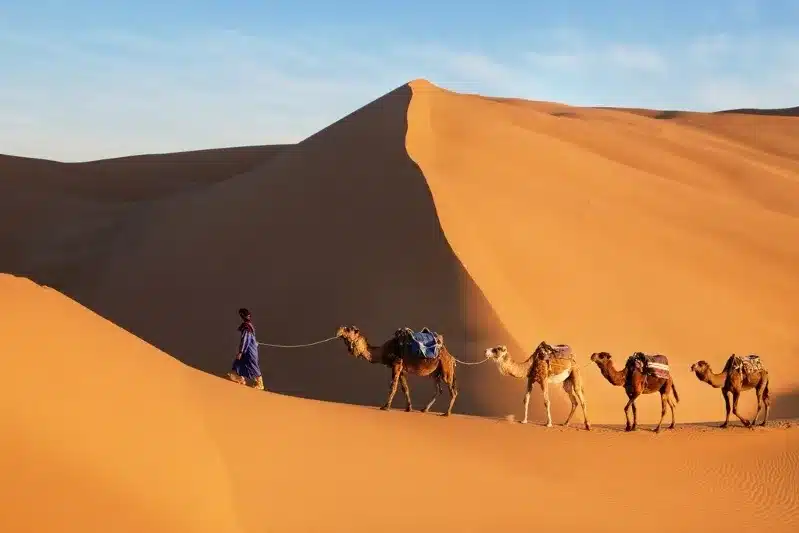
In short: Morocco’s desert in August is hot and quiet, with daytime highs regularly topping 40°C around Merzouga and the Sahara. It’s very doable if you time activities for early morning and after sunset, but if your dates are flexible the sweet spot is October to April.
August is peak summer in Morocco, and the Sahara doesn’t do subtle. I’ve crossed the pre-Sahara in high summer, and the heat is the single fact that shapes everything: what you wear, when you ride a camel, and how far you’re willing to drive in a day. Here’s what to actually expect.
How hot does it really get?
Around Merzouga and Erg Chebbi, daytime highs in August routinely sit above 40°C, and it can climb higher in the open dunes where there’s no shade. The saving grace is that the desert cools fast after dark, and nights are far more comfortable than the afternoons. This is the opposite of winter, when Sahara nights can turn genuinely cold. The practical takeaway: the middle of the day (roughly 12pm-4pm) is for staying still in shade, not for hiking dunes. For a fuller season-by-season breakdown, see our Morocco Desert guide.
Is it worth going in August at all?
Honestly, yes, if you’re realistic. The upside of travelling now is thinner crowds at the big dunes and often more room to negotiate. The downside is the heat and the long transfer drives, which are less pleasant in summer. If your trip is locked to August (school holidays, work leave), plan around the sun rather than fighting it. If your dates are open, the classic best season runs October to April, when daytime temperatures are milder and dune walks are a pleasure at any hour.
Which desert, and how far is it?
Morocco has more than one “desert,” and the distances are real. Erg Chebbi at Merzouga has the postcard dunes, some reaching around 150m. From Marrakech it’s roughly 560km and 9-10 hours of driving, which is why it’s almost always sold as a 3-day tour with an overnight stop. From Fes it’s closer, about 470km and 7-8 hours. If you’re short on time, Zagora is nearer, around 360km and about 7 hours from Marrakech, and works as a 2-day trip, though its dunes are smaller and less dramatic. For deep-desert solitude, Erg Chigaga near M’Hamid is remote and reached by 4×4, better suited to travelers with extra days.
What about Agafay, close to Marrakech?
If August heat and the long haul to Merzouga put you off, Agafay is the pragmatic answer. It sits about 40 minutes from Marrakech and is a rocky, stone desert, not sand dunes, so set your expectations accordingly. What it lacks in towering dunes it makes up for in access: you can do a sunset dinner or an overnight camp without committing to two or three days on the road. In summer, the same rule applies here, plan the good stuff for the cooler edges of the day.
How to plan the day around the heat
The rhythm that works in August is simple. Ride camels or walk the dunes at sunrise and sunset, when the light is best and the sand isn’t scorching. Rest through the harsh midday hours. Carry far more water than you think you need, cover your skin and head, and use real sun protection rather than relying on a hat alone. Sunset is the payoff moment, and after dark the sky over Erg Chebbi is extraordinarily clear, one of the genuine rewards of a summer night in the Sahara.
What does a summer desert tour cost?
Prices swing with group size, comfort level, and season, so treat any figure as a range. A shared 3-day Marrakech-Merzouga tour typically lands somewhere around 80-150 EUR per person, usually covering transport and a night at a desert camp, with camel rides and some meals often included. Private tours and upgraded camps cost more. Always confirm exactly what’s included, especially meals, camp category, and whether the camel ride is part of the price. For itinerary ideas and comparisons, our related guide lays out the options.
Frequently Asked Questions
Is August too hot for the Sahara? It’s hot, with highs above 40°C, but manageable if you schedule activities for early morning and evening and rest during midday. It’s not the ideal season, but it’s far from impossible.
When is the best time instead of August? October to April, when daytime temperatures are milder. Just note that Sahara nights in winter can get cold, so pack layers.
Should I choose Merzouga or Agafay in summer? Merzouga has the tall sand dunes but is 9-10 hours from Marrakech. Agafay is a rocky desert only 40 minutes away, ideal if you want to skip the long, hot drive.
How many days do I need? For Merzouga’s big dunes, plan 3 days from Marrakech. Zagora works as a 2-day trip but has smaller dunes. Agafay can be done in an evening or overnight.
What should I pack for August? Lightweight, covering clothing, a scarf or head covering, strong sun protection, and lots of water. A light layer for the cooler nights is still worth bringing.
👉 Planning your trip? Ask our local agency on WhatsApp.
Planning your trip? Explore our Morocco desert tours from Marrakech, 3-day Marrakech to Merzouga tour and 2-day Zagora tour.