
All our tours are private. These prices are for a private experience, not a shared group. We confirm the exact price on WhatsApp; you book directly with the local families and camps, no middlemen.
In short: A dromedary is simply one type of camel — the one-humped Arabian camel (Camelus dromedarius) that you ride in Morocco. The two-humped kind is the Bactrian camel of Central Asia. So in the Sahara near Merzouga, every “camel” you meet is technically a dromedary, and the words are used interchangeably here.
So what’s the actual difference?
The confusion is understandable, but the biology is simple. “Camel” is the umbrella term for the genus Camelus. Within it, the dromedary has a single hump and thrives in hot desert climates, while the Bactrian camel has two humps and is built for the cold, rocky steppes of Mongolia and Central Asia. When you book a “camel trek” in Morocco, you are booking a ride on a dromedary — there are no Bactrians roaming the dunes here. Locals and guides say “camel” in English and jamal in Arabic without a second thought, and nobody will correct you.
Which one will I ride at Erg Chebbi or Erg Chigaga?
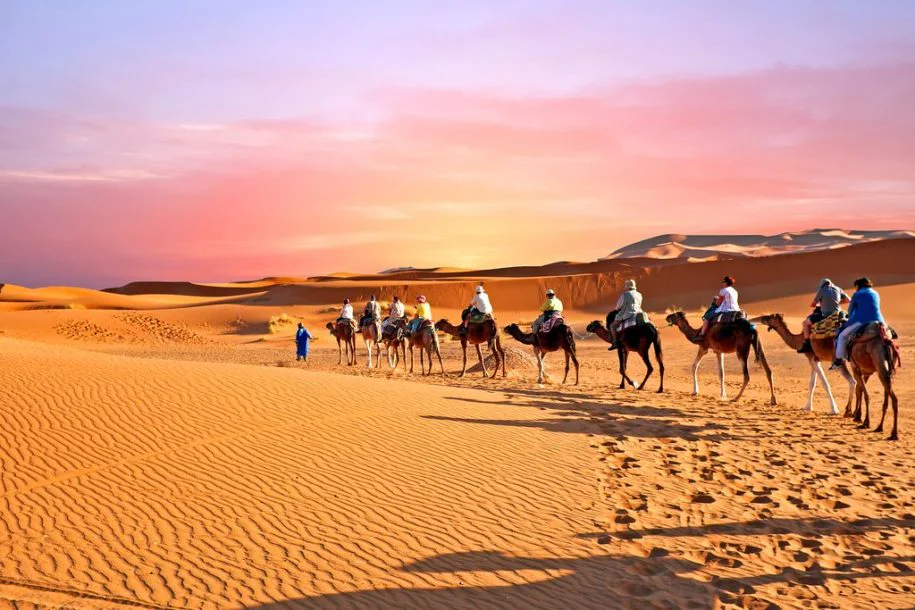
Always a dromedary. At Erg Chebbi outside Merzouga — where the tallest dunes climb to roughly 150 metres — the sunset caravans are single-humped Arabian camels, and the hump is exactly what you settle behind in the wooden saddle. The same is true at the more remote Erg Chigaga near M’Hamid, reached by 4×4 across open desert. On my first ride I expected a saddle between two humps like a cartoon; instead you sit just ahead of the one hump, on blankets, holding the front pommel while the animal lurches up back-legs-first. Lean back for that first rise or you will pitch forward.
Why does Morocco have only the one-humped kind?
Geography and heat. The dromedary evolved for exactly these conditions: the single hump stores fat (not water, a common myth) that the body converts to energy when food is scarce, and the animal can tolerate the Sahara’s punishing summers, when daytime temperatures push past 40°C. Bactrian camels, by contrast, grow a thick shaggy coat for freezing winters — useless in the Moroccan south. If you visit in winter you will notice the desert nights turn genuinely cold even here, but the dromedary handles the swing better than any two-humped cousin would in the heat.
Does the difference change my trip in any way?
Practically, no — but knowing you are on a dromedary helps set expectations for comfort. One hump means a narrower, more forward seat, so treks are usually kept short: 45 minutes to a couple of hours to reach a desert camp for the night, not all-day marathons. Most travelers reach the dunes on the classic 3-day Marrakech–Merzouga loop (~560 km, 9–10 hours of driving spread across days), on the shorter Marrakech–Zagora 2-day run (~360 km, ~7 hours each way), or from Fes (~470 km, 7–8 hours). Shared 3-day Merzouga tours typically land in the ~80–150 EUR per person range, camel ride and camp usually included — confirm what’s bundled before you pay.
What about the Agafay “desert” near Marrakech?
Worth clearing up, because it’s the biggest surprise for first-timers. Agafay, about 40 minutes from Marrakech, is a rocky stone desert — lunar, dramatic, but not sand dunes. You can still do a short dromedary ride across the stony hills at sunset, and it’s ideal if you don’t have the days to reach Merzouga. Just don’t expect towering sand; for that you need the deep south. For the full picture of routes and regions, see our Morocco Desert guide.
When should I go?
The sweet spot is October to April, when days are warm and pleasant for riding and photography. Summer is brutal in the Sahara — 40°C and up — so treks run at dawn and dusk only, if at all. Winter days are lovely but pack a warm layer: desert nights get properly cold, and the camp blankets earn their keep. Whatever the season, the animal under you is the same trusty dromedary.
Frequently Asked Questions
Is a dromedary a camel? Yes. A dromedary is one species of camel — the one-humped Arabian camel. All dromedaries are camels, but not all camels are dromedaries (the two-humped Bactrian is the other main type).
Do camels store water in their humps? No. The hump stores fat, which the body breaks down for energy. Their tolerance for dehydration comes from other adaptations, not a water tank in the hump.
Are there any two-humped camels in Morocco? Not in the wild or on treks. Bactrian camels belong to the cold deserts of Central Asia. Every camel you ride in the Moroccan Sahara is a single-humped dromedary.
How long is a typical camel ride in the dunes? Usually short — roughly 45 minutes to a couple of hours, most often the sunset ride out to a desert camp and back to a viewpoint in the morning.
Can I ride a camel near Marrakech without going to Merzouga? Yes — the Agafay stone desert is about 40 minutes away and offers short dromedary rides, though it has rocky terrain rather than sand dunes. See our related guide for options.
👉 Planning your trip? Ask our local agency on WhatsApp.
Planning your trip? Explore our Morocco desert tours from Marrakech, 3-day Marrakech to Merzouga tour and 2-day Zagora tour.