
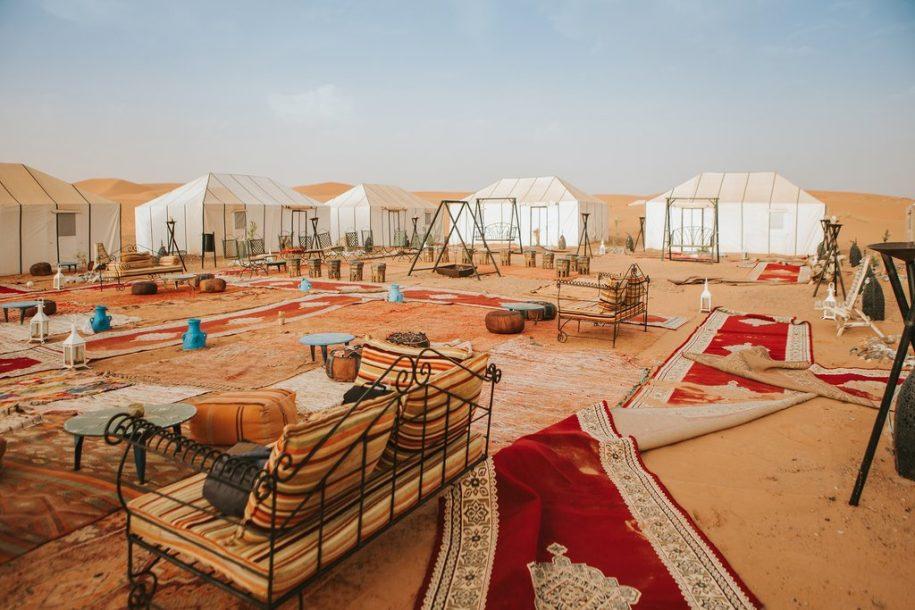
In short: Yes, scorpions and snakes live in the Moroccan desert, but they almost never bother travelers. On a normal Erg Chebbi or Erg Chigaga camp trip you are far more likely to be pestered by curious dune beetles than to ever see a scorpion. Basic caution (shake out shoes, use a torch at night) is all you need.
Are there really scorpions and snakes in the Moroccan Sahara?
There are, and pretending otherwise would be dishonest. Morocco’s pre-Saharan zones around Merzouga (Erg Chebbi) and M’Hamid (Erg Chigaga) are home to several scorpion species and a handful of snakes, including horned vipers that bury themselves in soft sand. But “present in the region” is very different from “a threat to your holiday.” These animals are shy, nocturnal, and spend the hot daylight hours hidden under rocks or buried in the dunes, precisely where tourists are not poking around. In dozens of camp nights, most travelers never see a single one. The desert’s real headline acts are the silence, the stars, and the 150m-tall dunes of Erg Chebbi, not its wildlife.
How dangerous are they, honestly?
Most scorpion stings in Morocco are painful but medically minor, comparable to a bad wasp sting: local swelling, throbbing, and a rough few hours. A small number of species carry more potent venom, and serious reactions are mainly a risk for small children and people with existing health conditions, not healthy adults. Snakes are even rarer to encounter; the venomous ones want nothing to do with you and will slip away if given the chance. Bites almost always happen when someone steps on or grabs an animal by accident. For an ordinary traveler doing a camel ride, a dune walk, and a night in a camp, the practical risk sits somewhere between “very low” and “negligible.
When and where are you most likely to encounter one?
Timing matters. The classic desert season runs October to April, when days are pleasant and nights can turn genuinely cold, cold enough that scorpions stay tucked away and inactive. Summer is the opposite: temperatures push past 40C and nocturnal creatures become far more active after dark, though that same heat is exactly why few tourists visit in July or August. Encounters, when they happen, tend to be at night, at ground level: near rocks at the base of dunes, under discarded shoes, or around camp edges where light and warmth gather. The rocky Agafay “desert” just 40 minutes from Marrakech is a different, stonier landscape and not a dune Sahara at all, but the same simple precautions apply there.
Private Morocco desert tours from Marrakech
Our private desert circuits leave from Marrakech with your own driver: 3 days to Merzouga from 385€ per person, 4 days to Erg Chigaga from 560€ per person.
How do desert camps keep guests safe?
Established camps around Erg Chebbi and Erg Chigaga are run by people who have lived with this environment their whole lives, and it shows. Tents sit on raised platforms or swept sand, beds are off the ground, and staff know exactly where animals like to shelter. Communal areas are lit at night, and guides carry torches as a matter of habit. On a typical shared 3-day Merzouga tour (roughly 80-150 EUR per person, covering transport, a night in a camp, and meals), the safety routine is so baked into the operation that you will barely notice it. This is a good reason to book through a real operator rather than winging a DIY bush camp. For the full picture on tours and logistics, see our Morocco Desert guide.
Simple precautions that actually matter
None of this requires special gear, just a few small habits. Shake out your shoes and boots before putting them on, every single morning. Keep a torch or phone light handy and look where you step around camp after dark. Don’t leave clothes, towels, or bags lying directly on the sand overnight; keep them zipped or on your bed. Never reach blindly under rocks or into crevices during dune walks. If you camp in summer, be a little more attentive at night. Do these and you have removed almost every realistic way a sting or bite could happen. Our related guide covers what else to pack for desert nights.
What will you actually see out there?
Far more than most people expect, and almost none of it alarming. The animals travellers come back talking about are the ones that move in daylight: the beetles that cross the sand leaving perfect tracks, the small lizards that bolt from under a stone when you sit down, the birds that appear at camp the moment bread comes out. At night the soundtrack changes rather than the scenery — a dog somewhere in the distance, wind on canvas, and silence of a kind that city travellers find genuinely strange for the first hour.
What you will not see, in all probability, is the thing you came here worried about. That is not reassurance for its own sake: it follows from how these animals live. They are nocturnal, they shelter from heat and cold in the same places — under rock, under scrub, buried in soft sand — and those places are not where a camp puts its tents or where a guide walks you. The mismatch between where you are and where they are is the whole reason encounters are rare, and it is also why the few precautions below work so well: they close the only gaps where the two overlap.
The habits that matter, and the ones that do not
Most desert safety advice online is padding. Here is the short version, split between what changes your risk and what changes nothing.
| Worth doing | Not worth worrying about |
|---|---|
| Shake out shoes and boots every morning before putting them on | Carrying antivenom or a snake-bite kit |
| Use a torch or phone light for any walk around camp after dark | Sleeping in a sealed tent with no air |
| Keep clothes, towels and bags off the ground overnight, zipped or on the bed | Avoiding the desert in the cool season, when activity is lowest anyway |
| Never reach blindly under a rock or into a crevice on a dune walk | Spraying a tent with insecticide |
| Keep children in footwear and within sight around camp at night | Checking a bed for hours before getting into it |
| Tell your guide immediately if anything stings or bites you | Trying to identify a species from a photograph afterwards |
The left-hand column takes about thirty seconds a day in total. The right-hand column is where anxious travellers spend their energy, and it buys nothing.
Season by season: activity against comfort
The two things line up in your favour, which is the detail most articles leave out. The months when the desert is pleasant are the months when nocturnal animals are least active, because the same cold nights that have you asking for an extra blanket keep them inactive under cover.
| Period | Nights | Nocturnal activity | Who travels then |
|---|---|---|---|
| October to April | Cool to genuinely cold | Lowest | Most visitors — the classic desert season |
| May and September | Mild | Rising | Shoulder season, still comfortable |
| June to August | Warm after dark, days past 40 °C | Highest after sunset | Few travellers, for the heat rather than the wildlife |
In other words, peak tourist season is also the low-risk season, and the one period when you would want to be a little more attentive at night is the period almost nobody chooses. If you are planning around weather rather than wildlife, our guide to the weather in the Agafay sets out what each month actually feels like.
Why the Agafay is a different question entirely
Everything above describes the dune Sahara — Erg Chebbi and Erg Chigaga, a long drive south. The Agafay is a rocky stone plateau about 30 km and forty minutes from Marrakech, and three things make it a milder proposition still.
First, it is stone and compacted earth rather than soft sand, so the burrowing habit that makes a dune hard to read does not apply in the same way. Second, most visits are day trips or a single evening: you arrive in the afternoon, eat at sunset and are back in your riad before midnight, which removes the night-time ground-level exposure almost entirely. Third, the camps sit on prepared platforms within sight of each other on an open plateau, not in a remote hollow. Travellers who are nervous after reading about the Sahara often find the Agafay is the version of the desert they were actually looking for.
If your worry is broader than wildlife — roads, water, being far from a hospital — we treat that separately in is the Moroccan Sahara safe, and the practical side of multi-day trips is covered in our Morocco desert tours overview.
What a well-run camp does that you never notice
The difference between a camp that has been operating for fifteen years and an improvised one is almost invisible to a guest, which is precisely the point. Beds sit off the ground on frames rather than on mattresses laid on sand. The ground inside and around the tents is swept, not because of appearances but because swept ground shows tracks and offers no cover. Paths between the tents, the dining area and the toilets are lit, so nobody crosses open ground in the dark guessing where to put a foot. Staff carry torches by reflex rather than by policy.
None of this is announced to you on arrival, and that is why booking through an operator who knows the camps matters more than any item you could pack. A DIY tent pitched on soft sand beside a rock outcrop reverses every one of those small decisions at once. For what to bring for a desert night, the clothing list matters more for the cold than for anything that crawls.
Is one region of Morocco riskier than another?
Not in any way that should steer your itinerary. The pre-Saharan zones around Merzouga and M’Hamid are the ones people ask about because that is where the dunes are, but the practical precautions are identical everywhere, including the Agafay and the Atlas valleys. Choose your destination on the landscape and the drive, not on this.
Do camps spray or treat the ground?
Reputable ones rely on the physical habits described above — raised beds, swept ground, lighting — rather than on chemicals, which would be both ineffective in open desert and unpleasant to sleep beside. If a camp tells you it sprays, that is a sign it is substituting a gesture for a routine.
Should I keep my tent zipped all night?
Zip it when you leave it and when you sleep, simply because it costs nothing. Do not seal yourself in a tent you cannot ventilate on a warm night: discomfort is the far more likely problem of the two, and desert nights in the cool season are cold enough that you will want the blankets more than the airflow.
My child is nervous after reading about this. What do I tell them?
That the animals are real, that they hide from people rather than seek them, and that the two jobs on the trip are shaking out shoes in the morning and holding a torch at night. Children who are given a task tend to stop being frightened of the thing the task addresses. It also happens to be accurate.
Frequently Asked Questions
Do I need antivenom or a special kit? No. Ordinary travelers don’t carry antivenom. Camps and guides know local protocols, and serious cases are referred to a clinic or hospital. Just keep your standard travel insurance and any personal medication with you.
Should I be worried about my kids? Small children are the group most worth watching, since stings affect them more. Keep them in footwear, use a light at night, and don’t let them play under rocks. With that, a family desert trip is perfectly reasonable.
Which season has the fewest scorpions? The cool months of October to April, the same window that’s best for comfort. Cold desert nights keep scorpions inactive, so peak tourist season is also the low-risk season.
Is Agafay near Marrakech risky? Agafay is a rocky stone desert 40 minutes from Marrakech, not dunes. Wildlife encounters there are just as unlikely; the same shake-your-shoes habits are more than enough.
What do I do if I actually get stung? Stay calm, keep the area still, and tell your guide or camp staff immediately. Most stings are managed with pain relief and observation; they’ll arrange medical help if anything looks unusual.
👉 Planning your trip? Ask our local agency on WhatsApp.