
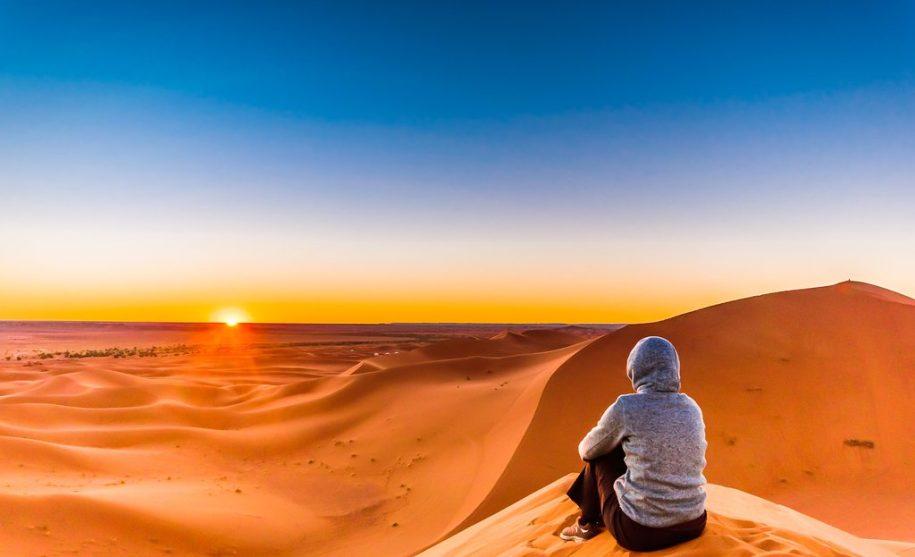
In short: Yes. The Moroccan Sahara is dotted with real palm-fed oases, from the vast Tafilalet groves around Rissani to the photogenic Fint oasis near Ouarzazate and the winding Draa Valley. Most sit a short drive from the dune fields at Merzouga and Zagora, so on a single Morocco desert tour you can pair towering sand with green palmeries in the same day.
What exactly is a Moroccan desert oasis?
A Moroccan oasis is not a single spring in empty sand. It is a cultivated corridor of date palms, fruit trees, alfalfa and small grain plots, watered by underground channels called khettaras, hand-dug wells, or a seasonal river (an oued). The tall palms shade a second layer of crops beneath them, a clever three-tier farming system that keeps the ground cool. Ksour (fortified mud-brick villages) and kasbahs usually cluster at the edge. So when travelers picture a lone pool ringed by palms, the reality is greener and more lived-in: working farmland, threaded with narrow irrigation paths, that has sustained Amazigh (Berber) and Saharan communities for centuries. Walk one in the late afternoon and you will pass farmers moving water between plots by opening small earth dams by hand.
Where are the main oases in the Moroccan Sahara?
The richest concentration is the Tafilalet, one of the largest palm groves in the world, spreading around Rissani and Erfoud in the southeast. Just beyond it lie Merzouga and the Erg Chebbi dunes, Morocco’s tallest at up to about 150 metres. To the southwest, the Draa Valley runs roughly 200 km from Agdz through Zagora toward M’Hamid, a near-continuous ribbon of palmeries following the Draa river. Near Ouarzazate, the compact Fint oasis (about 10 km off the main road) is a favorite for its film-set scenery. Further options include Tinghir and the Todra Gorge oasis, and the remote Figuig oasis on the Algerian border. For orientation across regions, our Morocco Desert guide maps how these link together.
| Oasis | Where it is | What it is known for | Reachable on |
|---|---|---|---|
| Tafilalet | Southeast, around Rissani and Erfoud | One of the largest palm groves in the world; the Erg Chebbi dunes rise just beyond it | 3-day Marrakech to Merzouga tour |
| Draa Valley | Southwest, from Agdz through Zagora to M’Hamid | Roughly 200 km of near-continuous palmeries along the Draa river — the longest in Morocco | 2-day Zagora tour |
| Fint | About 10 km off the main road near Ouarzazate | Compact oasis used as a film set | Dades and Todra route |
| Tinghir and the Todra Gorge | Between Ouarzazate and the gorges | Palm grove at the foot of the gorge walls | Dades and Todra route |
| Skoura and the Valley of the Roses | Between Ouarzazate and the gorges | Palm grove and rose-growing valley | Dades and Todra route |
| Iriki and the M’hamid oases | Far south, on the way to the big dunes | Last palmeries before Erg Chigaga | 4-day Erg Chigaga tour |
| Figuig | East, on the Algerian border | Remote oasis, far off the usual routes | — |
How do I combine dunes and oases on one trip?
Most itineraries route through the oases because the roads follow the water. A classic 3-day Marrakech-to-Merzouga loop crosses the High Atlas via the Tizi n’Tichka pass (about 4 hours to Ouarzazate), then threads the Dades and Todra valleys before reaching Erg Chebbi. A Zagora-focused trip follows the Draa Valley palmeries the whole way south. Expect roughly 560 km and 9-10 hours of driving from Marrakech to Merzouga, which is exactly why it is sold as a 3-day tour with an overnight in the Dades or near Ouarzazate rather than a dash. Along the way you pass working palm groves constantly, and many camps and guesthouses sit right on an oasis edge, letting you walk shaded palmeries in the morning and climb dunes at sunset the same day.
What is the best season to visit the oases?
October to April is ideal, with mild days of 18-25°C and cool, sometimes cold nights (near freezing in the depth of winter, so pack a fleece). Spring brings green palmeries and, in February, the date palms flowering. Autumn coincides with the date harvest (roughly September-October), when Erfoud and Rissani markets overflow with fresh dates. Summer (June-August) is punishing, often above 40°C, though the palm shade offers real relief at midday. Avoid planning long oasis walks in high-summer afternoons; go at first light instead.
What does an oasis-and-desert trip cost?
Shared 3-day tours from Marrakech to Merzouga typically run €80-150 per person, including transport, a desert-camp night and breakfasts. Private tours with a driver-guide range from about €250-500+ depending on group size and camp standard. A night in a desert camp near the dunes usually costs €30-120 per person, from basic to luxury tented suites. A local guide for a few hours of oasis walking is inexpensive, often €10-25. Prices climb over Christmas, New Year and Easter, so book those weeks early. For sample routes and inclusions, see this related guide.
Are the oases still working farms today?
Yes, though they face pressure. Many palmeries remain actively farmed for dates, olives, almonds and vegetables, and traditional khettara irrigation survives in places. But prolonged drought, dropping water tables and a palm disease known as bayoud have thinned some groves. Younger generations increasingly move to cities, so parts of the Draa and Tafilalet are quieter than a generation ago. Visiting responsibly, hiring local guides and buying dates or crafts directly from growers helps keep these communities viable.
Which oases you can actually visit, and on which tour
Every oasis below is on a route we drive ourselves, with a private vehicle and a driver-guide.
- Draa Valley palm groves, the longest in Morocco: on the 2-day Zagora tour, between Agdz and Zagora.
- Tafilalet and the Merzouga palm belt: on the 3-day Marrakech to Merzouga tour, from 385€ per person.
- Iriki and the M’hamid oases, on the way to the big dunes: on the 4-day Erg Chigaga tour, from 560€ per person.
- Skoura and the Valley of the Roses: on the Dades and Todra route, a natural stop between Ouarzazate and the gorges.
All our desert routes are private, which means the stops are yours to choose. See all private Morocco desert tours from Marrakech.
Oases or dunes: how to split your days
Two days take you to the Draa Valley and Zagora. Three days reach the Erg Chebbi dunes at Merzouga, with the palm groves on the way. Four days add Erg Chigaga, the wilder erg, and the Iriki plain. If you only have one day, the Agafay Desert near Marrakech is the realistic option: it is a stone desert, 40 minutes away, with activities from 30€.
These oases string together along well-travelled roads — the Morocco road trip itinerary shows how to link them into one drive.
Frequently Asked Questions
Is Merzouga an oasis or a dune desert? Both are close together. Merzouga village sits beside the Erg Chebbi dunes, while the broad Tafilalet palm groves lie just to the north around Rissani and Erfoud, so you get sand and palmeries within the same area.
Which oasis is easiest to reach from Marrakech? The Fint oasis near Ouarzazate is the most accessible, roughly 4 hours’ drive over the Tizi n’Tichka pass plus a short 10 km side road, making it doable even on a shorter southern loop.
Can you swim in a Moroccan oasis? Sometimes. A few oases like Fint have shallow river pools or seasonal water, and some camps have small pools, but many groves rely on irrigation channels not meant for swimming. Always ask locally first.
Do I need a 4×4 to see the oases? No. The main oases along the Draa Valley, Todra and Tafilalet are reached on paved roads by regular car or tour minibus. A 4×4 is only needed for off-piste tracks and remote camps such as those near Erg Chigaga.
Are dates from these oases safe to buy? Yes, and they are a highlight. Rissani and Erfoud are famous date-trading hubs; buying fresh or dried dates directly from local souks is both safe and a good way to support growers.
👉 Planning your trip? Ask our local agency on WhatsApp.