
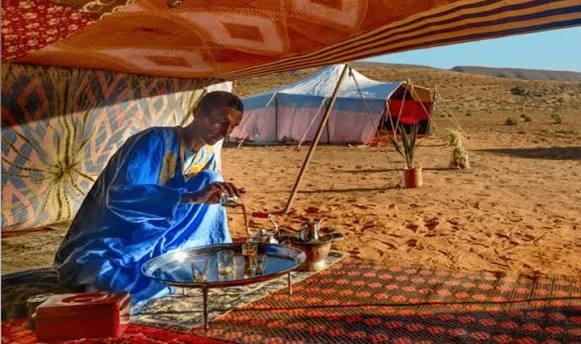
In short: For Sahara desert photography in Morocco, the golden dunes of Erg Chebbi (near Merzouga) and Erg Chigaga (near M’Hamid) deliver the classic high-dune shots, while the Agafay stone desert about 40 km from Marrakech is the fastest option for sunrise-to-sunset light. Shoot in the soft window one hour after sunrise and before sunset, protect your gear from fine sand, and plan around the March-May and September-November seasons for the cleanest skies.
Where are the best Sahara photography spots in Morocco?
Three landscapes dominate a photographer’s shortlist. Erg Chebbi, reached via Merzouga about 560 km (9-10 hours, usually a 3-day tour) east of Marrakech, offers Morocco’s tallest dunes, up to about 150 m, that glow deep orange-red at dawn, plus reflective seasonal lakes near Merzouga where flamingos appear in spring. Erg Chigaga, reached past M’Hamid by 4×4 (roughly a 4-5 hour drive from Ouarzazate to M’Hamid, then a sandy track into the erg), is wilder, less crowded, and better for star fields because there is almost no light pollution. Closer to home, the Agafay desert is a moon-like expanse of grey-beige hills and shale just 40 km (about 40 minutes) from Marrakech, ideal if you only have a day and want camel silhouettes against the Atlas Mountains. For the full picture of each region, see our Morocco Desert guide.
When is the best light and season to shoot?
Plan around two daily windows. The first hour after sunrise and the last hour before sunset give you long shadows that reveal the ripples and ridgelines of the dunes; midday flattens everything and burns out detail. Blue hour, the 20-30 minutes after sunset, is when the sand turns violet and the first stars emerge. Season matters just as much: March-May and September-November bring stable, clear skies and comfortable temperatures within the desert’s best October-to-April window. Summer (June-August) pushes past 45°C and often carries dust haze that dulls contrast, while winter mornings in the deep Sahara can drop near freezing but reward you with crisp, sharp air. New-moon nights in any of these months are essential for Milky Way work.
What camera gear and settings work in the dunes?
A wide-angle lens (16-35 mm equivalent) captures sweeping dune lines, while a short telephoto (70-200 mm) compresses distant ridges into abstract layers and isolates a lone camel train. Bring a sturdy but light tripod for blue hour and astro shots, a polarising filter to deepen the sky, and at least one graduated ND to balance bright sand against a dark foreground. For the Milky Way, use a fast wide lens at f/2.8, ISO 3200-6400, and a 15-20 second exposure. The biggest practical enemy is dust: keep a rocket blower and microfibre cloths handy, change lenses inside a bag or your vehicle, and seal everything in zip bags overnight because the fine Saharan sand works into every seam.
How do you photograph camels, camps and people respectfully?
Camel caravans are the signature Sahara image, and they read best as silhouettes against a low sun, shot from a slightly low angle so the animals break the horizon line. Remember the trek moves at a slow walking pace, roughly an hour to camp, so you have time to get ahead and set up. Ask your guide to walk the caravan across a clean dune crest rather than through churned-up sand. When photographing Amazigh (Berber) hosts, nomads, or camp staff, always ask first; a smile and a few words of Arabic or French go a long way, and many will happily pose. Offering to show them the frame or send a copy builds trust. Camps with white tents and lantern-lit dinners make strong twilight compositions, so scout your camp on arrival while there is still light.
How much does a photography-focused desert trip cost?
Costs vary by distance and comfort. A shared 3-day trip to Erg Chebbi from Marrakech runs in the usual range of roughly 80-150 EUR per person including transport, camp and meals, though group timing rarely lines up with golden hour. A private tour with a driver who will stop for the light and wait for blue hour costs more, typically a few hundred euros per day depending on the vehicle and camp standard, and it is the single best investment for serious photography because you control the schedule. Agafay is the budget-friendly entry point: a half-day with camel ride and sunset is the cheapest way to shoot desert light, with overnights in a design camp costing more. Our Morocco Desert guide breaks down camps and logistics in detail.
Frequently Asked Questions
Is Agafay a real desert for photos or just marketing? Agafay is a rocky, stony desert rather than a sand-dune erg, but its lunar terrain, Atlas Mountain backdrop and easy 40-minute access from Marrakech make it genuinely photogenic, especially at sunset and under stars.
Can I fly a drone in the Moroccan desert? Drones are heavily restricted in Morocco and often require prior authorisation; many are held at the airport on arrival. Do not assume you can fly, and check current rules or ask your local agency before travelling.
How do I protect my camera from sand? Keep gear in sealed bags, change lenses inside your vehicle or a bag, use a rocket blower rather than wiping, and never leave equipment exposed during wind. Fine Saharan sand is far more invasive than beach sand.
Which desert is best for the Milky Way? Erg Chigaga near M’Hamid has the darkest skies and least light pollution, making it the top choice for astrophotography, followed by the remote dunes beyond Merzouga on a new-moon night.
Do I need a 4×4 to reach the dunes? For Erg Chebbi a normal car reaches Merzouga, then camels or 4×4 take you into the dunes; Erg Chigaga must be reached by 4×4 over a sandy track, while Agafay is reachable by ordinary car.
👉 Planning your trip? Ask our local agency on WhatsApp.
Planning your trip? Explore our Morocco desert tours from Marrakech, 3-day Marrakech to Merzouga tour and 2-day Zagora tour.