
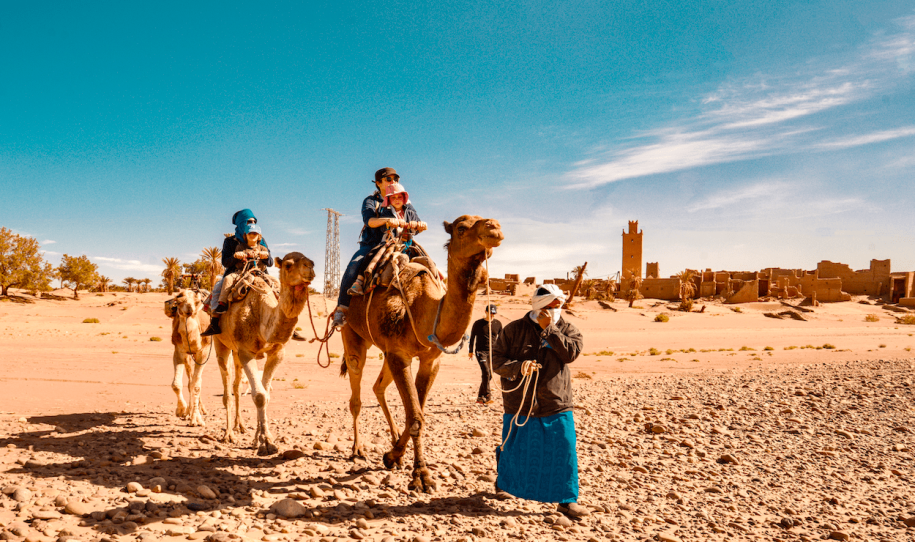
In short: Zagora’s famous “Tombouctou 52 jours” (Timbuktu 52 days) sign refers to the old caravan route across the Sahara that took roughly 52 days by camel to reach Timbuktu in Mali, about 2,000 km away. The original hand-painted mud wall marker is long gone, but a modern replica stands at the southern edge of Zagora and is one of Morocco’s most photographed roadside icons.
Planning a desert trip? See all private Morocco desert tours from Marrakech.
What does the “52 days to Timbuktu” sign actually mean?
The sign marks the historic terminus of the trans-Saharan caravan trade. From Zagora, a fully loaded camel caravan carrying salt, gold, ivory, textiles and enslaved people would set out across the desert toward Timbuktu, a journey of about 52 days on foot and by camel. That figure was not a fixed distance but an average travel time under caravan conditions, covering roughly 40 km per day across some 2,000 km of sand, hamada and open desert. Zagora was one of the last real towns before the emptiness of the deep Sahara, which is exactly why the marker sits here and not further north.
Is the sign in Zagora real or a replica?
The image most travelers picture, a crude blue-and-white slogan painted on a mud wall, dates from French colonial times in the early-to-mid 20th century and has weathered away. What you see today is a maintained replica, a proper painted signpost reading “Tombouctou 52 jours” beneath a small camel-and-rider silhouette. It stands on the P31 road at the southern end of Zagora, near the turnoff toward M’Hamid. It is free to visit and takes five minutes, so treat it as a fun photo stop rather than a destination in itself.
Where exactly is it and how do I get there?
Zagora sits in the Draa Valley in southeastern Morocco, about 165 km south of Ouarzazate and roughly 360 km from Marrakech. Driving from Marrakech takes around 6.5 to 7.5 hours, crossing the Tizi n’Tichka pass (2,260 m) through the High Atlas. The sign is on the main road as you leave Zagora heading south, so any grand taxi, tour vehicle or private car will pass close to it. Most organised tours from Marrakech include a quick stop here on the way to the dunes. For deeper context on the region, see our related guide to the Zagora desert.
Should Zagora be your desert base, or push on to the dunes?
Zagora itself is a working town, not a dune sea. The nearest small dunes, Tinfou, are modest. For the classic golden dunes, most travelers continue about 95 km further south to M’Hamid El Ghizlane, the true end of the tarmac and gateway to Erg Chigaga’s big dunes (a 1.5 to 2 hour 4×4 ride beyond M’Hamid). If your priority is dramatic sand, Erg Chigaga or the more famous Erg Chebbi near Merzouga will impress more; if you want authentic Draa Valley palm groves, history and a shorter drive, Zagora works well. Compare the options in our full Morocco Desert guide.
What does a Zagora desert trip cost and when should I go?
A shared 2-day/1-night Zagora tour from Marrakech, including transport, a camel ride and a night in a standard camp, typically runs about 45 to 90 EUR per person. Private tours and upgraded camps push higher, roughly 120 to 250 EUR per person depending on group size and comfort. Erg Chigaga trips out of M’Hamid cost more because of the extra 4×4 leg. The best months are October to April, when daytime temperatures are pleasant (roughly 18 to 28 C); midsummer (June to August) regularly exceeds 40 C and is best avoided. Desert nights are cold from December to February, so pack layers.
Is the “52 days” claim historically accurate?
Broadly, yes, with nuance. Trans-Saharan caravans genuinely took around six to eight weeks between the Draa oases and Timbuktu, and 52 days is a well-known traditional estimate popularised in the colonial era. Actual timing varied with the season, the size of the caravan, water availability and the specific route. The trade itself was real and centuries old: Zagora and the wider Draa were caravan staging points from at least the medieval period, connecting Morocco’s cities to the gold and salt of West Africa. The number is a symbol of that history as much as a precise measurement.
Frequently Asked Questions
How far is Timbuktu from Zagora? Roughly 2,000 km in a straight desert line, historically a caravan journey of about 52 days by camel. There is no practical tourist route today; the border region is closed and unsafe for travel.
Can I actually travel from Zagora to Timbuktu? No. Modern security conditions and closed borders in Mali and the surrounding Sahara make this route inaccessible to travelers. The sign is symbolic and historical only.
Is it worth stopping at the sign? Yes for a quick photo and a bit of history, but it is a five-minute roadside stop, not a main attraction. Combine it with a camel ride, a Draa Valley palm grove walk or an onward dune trip.
How long should I spend in Zagora? One night is enough for most travelers to see the sign, ride a camel and sleep in a desert camp. If you want the big dunes of Erg Chigaga, plan two to three days including M’Hamid.
Do I need a 4×4 to reach the sign? No. The sign is on paved road at the edge of town and any normal car or taxi reaches it. A 4×4 is only needed for the dunes beyond M’Hamid.
👉 Planning your trip? Ask our local agency on WhatsApp.
Ready to book this trip? We run it as a private tour: 2 Days to Zagora from Marrakech. Message us on WhatsApp for dates and a quote.