
Camel Handling Day in the Agafay Desert — Saddle and Lead Your Own Camel
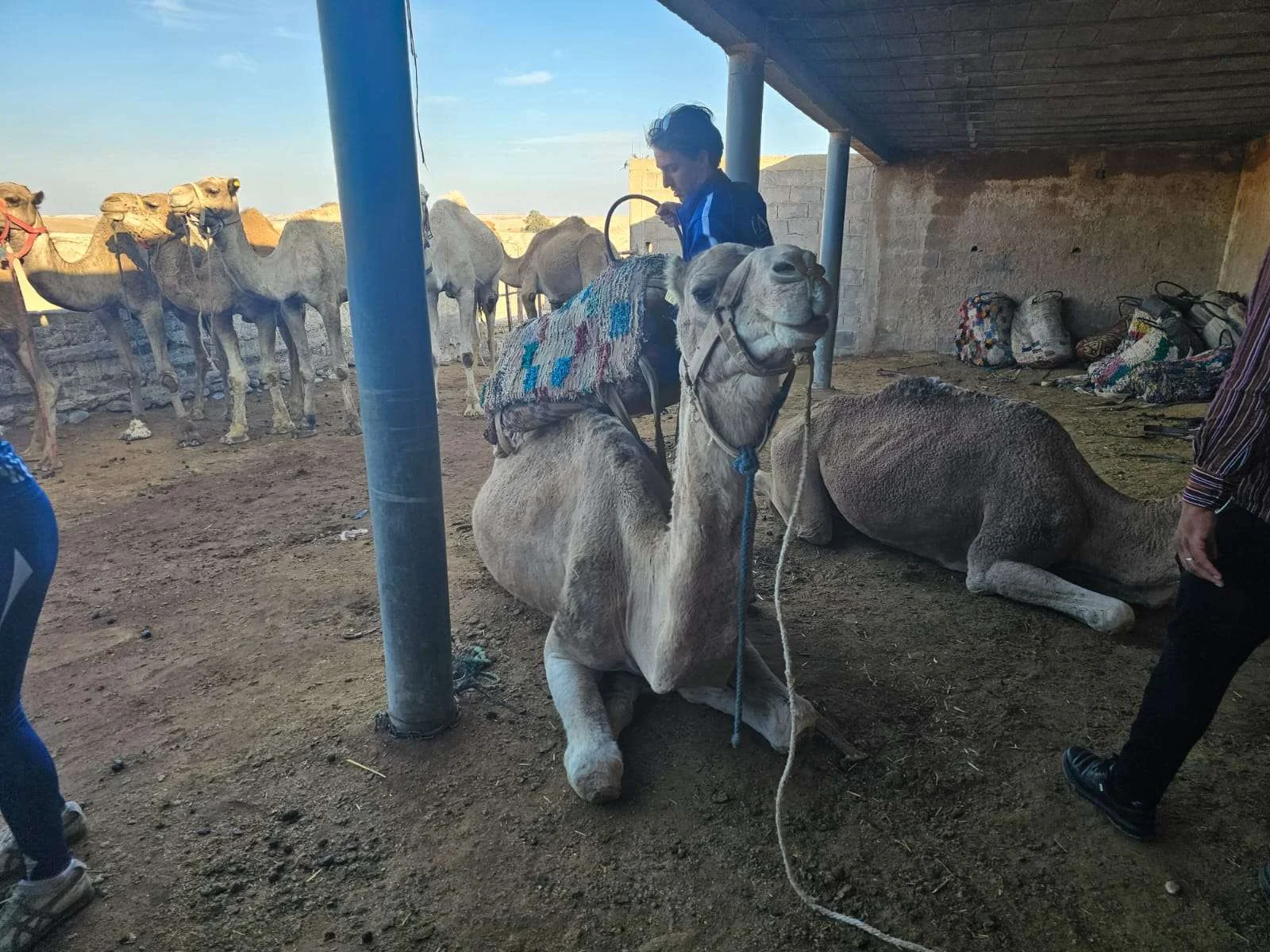
At a glance
| What | A full day spent learning to handle a camel, not just sit on one. You brush it, saddle it yourself, learn the voice commands its handler uses, and then ride the animal you prepared. |
|---|---|
| Where | The Agafay desert, 30 km south-west of Marrakech, with the handlers who keep the herd there. |
| Price | 170 € per person, lunch and round-trip transport from Marrakech included. |
| Group | Private only. We take one booking per day, so the handler works with your group and nobody else. |
| How long | A full day, roughly 09:00 to 17:00, adjusted to the season. |
| Booking | WhatsApp +212 661 454 738. Tell us the date and how many you are. |
All our tours are private. We confirm the exact price for your date and group size on WhatsApp; you book directly with the local families and camps, no middlemen.
Almost every camel experience sold around Marrakech is the same thing: you arrive, someone hands you a camel that is already saddled, you sit on it for forty minutes in a line of other visitors, you get off, you leave. The animal stays a prop. You never learn anything about it.
This day is the opposite. You spend it with the handlers who actually keep the herd in the Agafay, and you do the work they do. You meet your camel before it is ready. You brush it, you fit its blankets and its saddle, you learn how it is asked to kneel and to stand, and you learn the words it has been trained to answer. Only then do you ride — the animal you prepared yourself, led by nobody.
As far as we know we are the only ones running this in the Agafay. Everyone else sells the ride. We sell the day that makes the ride mean something.
Why nobody else does this
Three reasons, and they are all about the animals rather than the market.
The first is that it takes a handler off the rotation for a whole day. A camel operator running back-to-back forty-minute rides moves dozens of people through one handler. Teaching one small group costs him the day.
The second is that not every camel can be handled by a beginner. A camel that will stand still while a stranger tightens its girth, and kneel on command for someone it met an hour earlier, is a calm and well-worked animal. The handlers choose which camels do this, and they will not use the nervous ones.
The third is simply that it is harder to sell than a ride. It needs explaining, which is what this page is for. A ride needs none.
How the day runs
The schedule below is what a normal day looks like. The real times shift with the season — in July we start earlier and break longer at midday, in January we lose the light before 18:00 — and we confirm yours when we confirm the booking.
| Time | What you are doing | Roughly |
|---|---|---|
| Around 09:00 | We collect you in Marrakech and drive out to the Agafay. Mint tea on arrival, and you meet the handler and the herd before anything is touched. | 1 h 30 |
| Mid-morning | Your camel is chosen for you, and you get to know it on the ground: how to approach it, where it does and does not like to be touched, how to read whether it is relaxed. | 45 min |
| Late morning | Grooming and saddling. Blankets, then the saddle, then the girth. You do it; the handler corrects you. | 1 h |
| Before lunch | The commands. Kneel, stand, walk on, stop, turn. This is the part everybody remembers. | 45 min |
| Midday | Lunch under the tent with the handlers. Long, because the heat makes it sensible and because this is when the stories come out. | 1 h 30 |
| Afternoon | The ride. Not a loop around a paddock — a proper walk out into the hills on the camel you prepared, with the handler alongside rather than leading. | 2 h |
| Late afternoon | Unsaddling, which matters as much as saddling, then tea. We drive you back to Marrakech. | 1 h 30 |
Meeting your camel before it is ready
The first thing you learn is that a camel is not a horse and does not want to be treated like one. It is slower to startle but longer to forgive. It watches you approach, and the way you approach decides most of how the rest of the day goes.
You will be shown where to stand so the animal can see you, how to let it take your smell, and the places on the neck and shoulder where contact is welcome. You will also be shown the places where it is not, and why. None of this is ceremony: it is how the handlers themselves work, several times a day, with animals that outweigh them by half a tonne.
Dromedaries in the Agafay are working animals that have been handled since they were young. They are calm. But they are also opinionated, and a camel that has decided it does not want to stand up is a lesson in patience that no amount of pulling will shorten.
Grooming and saddling it yourself
This is the part visitors never see, and it is the part that turns a camel from scenery into an animal you have a relationship with.
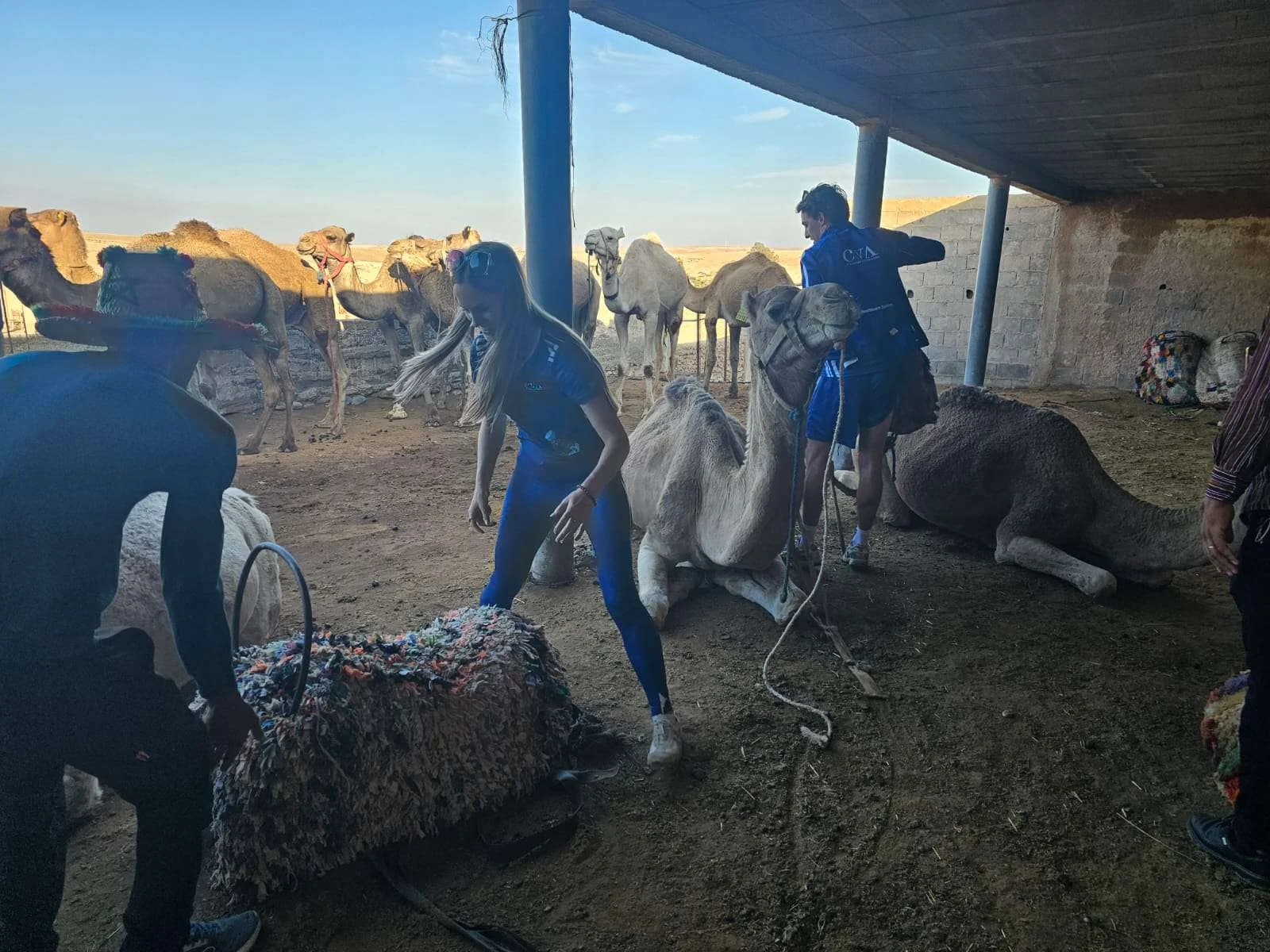
You start by brushing — the coat holds the pale Agafay dust, and brushing it out is both practical and the easiest way to get the animal used to you. Then come the blankets, folded and laid over and around the hump in a specific order, because the saddle must never sit on the hump itself. Then the wooden saddle frame on top. Then the girth, tightened in stages rather than all at once, with the camel kneeling throughout.
The handler will make you redo it. Probably twice. A girth that is slightly loose is the single most common beginner’s mistake and the one that matters most once the animal stands up, so he is strict about it and he is right to be.
- Blankets before saddle, always. The hump carries no weight directly.
- Girth tightened in stages, and checked again after the camel stands.
- Nothing hanging loose. A strap swinging against the flank is how a calm camel stops being calm.
- Unsaddling is part of the job. You will do that too, at the end of the day, when you are tired — which is exactly the point.
Learning to talk to a camel: the commands
Moroccan camel handlers work almost entirely by voice. There is no bit, no reins in the European sense, and very little pulling. The camel has been trained since it was young to answer a short list of sounds, and once you know them the animal does what you ask without being forced.
The one everybody comes away repeating is the command to kneel. Written the way it sounds, it is « ouch » — a short, low, slightly guttural sound, repeated calmly rather than shouted. Said properly, the camel folds its front legs and goes down, and you can get on or off. Said badly, nothing happens at all, and the handler will laugh at you before showing you again. Most people get it in about ten minutes and spend the rest of the day using it on everything, including each other.
| What you want | How it is asked | What to expect |
|---|---|---|
| Kneel down | « ouch », low and repeated, with a light downward signal on the headrope | Front legs fold first, so the animal tips forward before it settles. Lean back, not forward. |
| Stand up | A rising call with the headrope lifted | Back legs first, so you are tipped forward this time. The handler will tell you when to brace. |
| Walk on | A clicking sound with the tongue, plus a light touch | A slow start. Camels do not accelerate; they decide. |
| Stop | A long drawn-out sound, and slack in the line | Immediate on a well-worked camel, eventually on a stubborn one. |
| Turn | The headrope to one side, and your weight with it | Wide turns. A camel is not a bicycle. |
What surprises most people is how quiet all of it is. There is no shouting and no force anywhere in the day. A handler who has to raise his voice has already lost the argument, and he knows it.
Lunch with the handlers
Lunch is included and it is not a buffet. You eat what the handlers eat, under the tent, sitting down, in the middle of the day when nobody sensible is outside. Expect salads, bread baked that morning, a tagine, fruit and a great deal of mint tea.
Tell us when you book if anyone is vegetarian or has an allergy. Moroccan cooking makes this easy, but the food is cooked for the number of people we gave them, so the kitchen needs to know in advance rather than on the day.
What is included, and what is not
- A full day with the handler and the herd, as a private booking
- Your camel for the day: grooming, saddling, commands and the afternoon ride
- Lunch under the tent, mint tea through the day, and drinking water
- Round-trip private transport from Marrakech, hotel or riad pick-up, included in the 170 €
- A guide with you the whole day, so nothing is lost in translation
Not included
- Drinks beyond tea and water
- Tips, never expected and always welcome
- Anything you add to the day — a night in a camp afterwards, a quad session, a private dinner. Ask and we will quote it.
Who this day is for
It suits people who find the standard forty-minute ride faintly embarrassing and want to understand the animal instead. It suits photographers, because the morning with the herd gives you the pictures nobody else comes home with. It suits families with older children, who take to the commands faster than their parents. And it suits anyone who has ridden horses and is curious how different this actually is — the answer is: completely.
It does not suit you if you have half a day. It does not suit you if you want a photograph on a camel and nothing more, in which case our one-hour ride is cheaper and perfectly honest about what it is. And it is not a trekking course: you will ride for about two hours, not all day.
What to wear and bring
| Bring | Why | |
|---|---|---|
| Clothes | Long trousers and sleeves you do not mind ruining | You will be brushing a dusty animal and handling blankets. Agafay dust is fine, pale and permanent. |
| Shoes | Closed shoes with a flat sole | You are on stony ground around a large animal all morning. Sandals are refused. |
| Head | A hat, and a scarf if you have one | There is no shade between the tents, and the scarf doubles for the dust. |
| Sun | Sunscreen, applied before you arrive | Even in winter. The light off the white hills is stronger than it feels. |
| Winter | A real jacket from November to February | The mornings are cold before the sun gets up over the Atlas. |
How this compares with our other camel experiences
We sell five. This table is here so you book the one you actually want rather than the first one you found.
| Experience | What it is | Price |
|---|---|---|
| This day — camel handling | A full private day: prepare your own camel, learn the commands, then a two-hour ride. Lunch and transport included. | 170 € per person |
| Camel ride, one hour | The classic: a led ride at sunset, no preparation, no commands. Short and good value. | 30 € per person |
| Camel ride with lunch | The ride plus lunch in a camp. Half a day. | 71 € per person |
| Sunrise ride with breakfast | Early start, the best light of the day, breakfast afterwards. | 78 € per person |
| Quad, camel and lunch | A full day, but an activity day: an hour of quad, a camel ride, lunch. | 104 € per person |
Frequently asked questions
How much is the camel handling day?
170 € per person, with lunch and round-trip private transport from Marrakech included. There is nothing else to pay on site. It is a private booking: we take one group per day.
Do I really saddle the camel myself?
Yes, that is the point of the day. You brush it, lay the blankets, fit the saddle and tighten the girth, with the handler watching and correcting you. He checks everything before the animal stands up and before you get on — your work is real, but it is not unsupervised.
What is the command that makes a camel sit down?
Written phonetically it is « ouch »: a short, low sound repeated calmly rather than shouted, with a light downward signal on the headrope. The camel folds its front legs first and settles. Most people have it working within ten minutes.
Is it safe? I have never been near a camel.
The camels used for this are calm working animals chosen by their handlers precisely because they tolerate beginners, and a handler is beside you from the first minute to the last. The riskiest moments are when the animal kneels and stands, because it tips you forward and back, and you are told exactly how to brace for both.
Can children do it?
Older children, yes, and they usually learn the commands faster than the adults. Tell us their ages when you ask and we will say honestly whether the day will work for your group — a full day around animals is long for a small child.
How long are you actually on the camel?
About two hours, in the afternoon, once the heat has gone off. The rest of the day is on the ground with the animal, which is what makes it different from a ride.
Is lunch included, and can you cater for vegetarians?
Lunch is included, eaten under the tent with the handlers. Vegetarian is easy and so are most allergies, but tell us when you book rather than on the day, because the food is cooked for the number of people we gave them.
What happens if it rains?
Rain is rare in the Agafay. If the forecast is genuinely against us we move the date or cancel at no charge, and we tell you the evening before rather than on the morning.
Can we add a night in a desert camp afterwards?
Yes, and it is the most common addition. You finish the day with the herd and sleep in the desert instead of driving back. Ask us and we will quote the camp with it.
Book the day
170 € per person, lunch and transport included, one booking per day. Send us the date and the number of people: we confirm the handler, the camels and the pick-up time, and we tell you straight away if the day is already taken. We are a Marrakech agency and you book direct with us.