
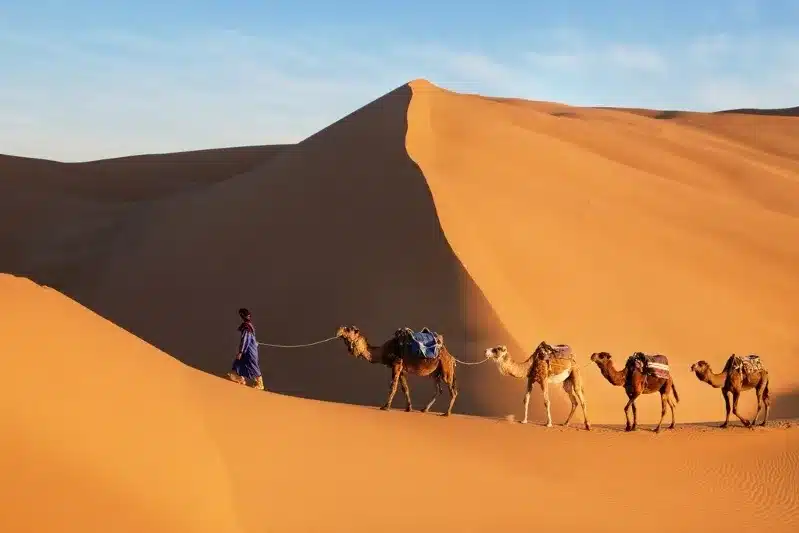
In short: A Sahara photography workshop pairs Morocco’s most photogenic dunes at Erg Chebbi (near Merzouga, with crests reaching about 150m) with dawn and dusk light and a guide who knows where to stand. Most travelers join a shared 3-day Merzouga tour (roughly 80-150 EUR per person) from Marrakech, then add a dedicated photo focus. The best window is October to April, when light is soft and temperatures are workable.
Why the Moroccan Sahara is built for photography
The draw is simple: scale and light. At Erg Chebbi outside Merzouga the tallest dunes climb to around 150m, and their east-west orientation means the sand catches long shadows at both sunrise and sunset. Ridgelines curve into clean S-shapes, wind ripples add foreground texture, and a lone camel train gives you the human element every desert frame wants. Further southwest near M’Hamid, the remote sea of dunes at Erg Chigaga is reached only by 4×4 and rewards you with almost no other tourists in frame. One tip from experience: the best shots are rarely at the summit you sweated up, but on the shaded flank just below it, where a single unwalked ripple can carry an entire composition.
What does a Sahara photography workshop actually cover?
A genuine workshop is more than a tour with a camera. Expect a golden-hour brief before you climb, guidance on exposing for bright sand without blowing highlights, and help finding leading lines instead of shooting flat, midday-washed dunes. Good guides plan the day around light: an early climb for the blue-to-gold transition, rest through the harsh middle hours, then a sunset position scouted in advance. Nights are the other half of the value. With almost no light pollution over Erg Chebbi, the Milky Way is often visible to the naked eye in clear months, so a session on long exposures, star trails, and lighting a foreground camp is usually part of the deal. Bring a sturdy tripod, spare batteries (cold nights drain them fast), and a rocket blower, because sand gets everywhere.
How do you get there, and how long do you need?
Merzouga and Erg Chebbi are the standard base. From Marrakech it is roughly 560km and 9-10 hours of driving, so it is almost always sold as a 3-day, 2-night loop over the High Atlas via the Tizi n’Tichka pass. From Fes the run is shorter at about 470km and 7-8 hours, which some photographers prefer for spending less time in the van. If your schedule is tight, the Zagora option from Marrakech is about 360km and 7 hours as a 2-day trip, but be honest with yourself: Zagora’s dunes are smaller and less dramatic than Erg Chebbi, so for serious dune photography the extra day to Merzouga is worth it. For a deeper route breakdown see our Morocco Desert guide.
When should you go for the best light?
Aim for October to April. In those months the air is clearer, midday heat is manageable, and the low sun angle gives you longer, richer golden hours at both ends of the day. Summer is punishing: 40C and above makes climbing dunes with gear genuinely risky, and heat haze softens distant detail. Winter flips the problem at night, when desert temperatures drop sharply and star sessions demand a warm layer, gloves, and a hat. Whatever the season, a slight breeze is your friend for erasing footprints between shots, and a still morning after wind gives you pristine, untouched ripples.
Is Agafay a good alternative for a photo day?
Agafay is worth understanding clearly before you book. It sits about 40 minutes from Marrakech and is a rocky, stone desert, not a sea of sand dunes, so it will not give you the towering Erg Chebbi ridgelines. What it does offer is convenience and drama of a different kind: lunar-looking terrain with the snow-capped Atlas as a backdrop, ideal for a half-day or sunset shoot when you cannot spare three days for Merzouga. Treat Agafay as a fast, accessible landscape session rather than a substitute for the classic Sahara dunes. More context sits in our related guide.
Frequently Asked Questions
How much does a Sahara photography workshop cost? The transport-and-camp backbone is usually a shared 3-day Merzouga tour at roughly 80-150 EUR per person; a dedicated photo focus or private guide adds to that depending on group size and how specialized the instruction is.
Do I need a professional camera? No. A mirrorless or DSLR helps for night skies, but the light and compositions matter more than the body. A modern phone in manual mode captures excellent golden-hour dune shots.
Can I photograph the Milky Way at Erg Chebbi? Yes, on clear nights in the darker months. Bring a tripod and shoot around the new moon for the darkest sky and strongest star detail.
Is one night in the desert enough? One night gives you a sunset, a night sky, and a sunrise, which covers the core photographic moments. Two nights lets you scout compositions and reshoot if weather or haze interferes.
How do I protect gear from sand? Change lenses inside the vehicle or tent, keep a rocket blower and microfibre cloth handy, and seal your bag when you are not actively shooting.
👉 Planning your trip? Ask our local agency on WhatsApp.
Planning your trip? Explore our Morocco desert tours from Marrakech, 3-day Marrakech to Merzouga tour and 2-day Zagora tour.