
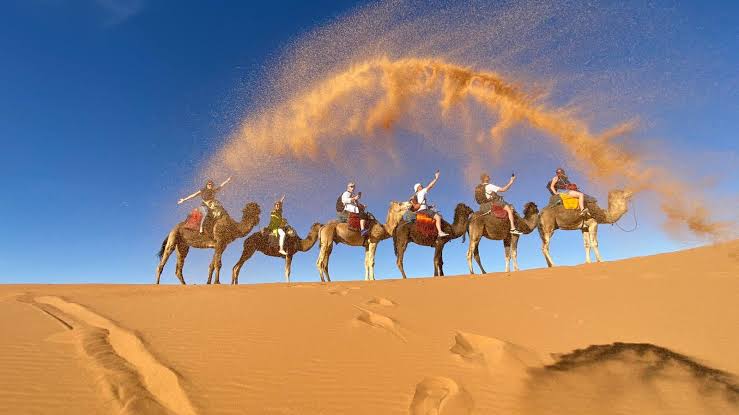
In short: A 2-night camel trek in Merzouga pairs two evenings under the stars of Erg Chebbi with a full day exploring the dunes, small desert villages, and quiet Saharan trails. It is the sweet spot for travelers who find one night too rushed but cannot spare a week, and it works best between October and April.
Comparing camps? See all our Agafay desert camps, how to choose the right camp and the Agafay day pass guide.
What does a 2-night camel trek in Merzouga actually involve?
Most 2-night camel treks start from Merzouga village, at the western edge of Erg Chebbi, where the tallest dunes rise to roughly 150 metres. You typically ride out by camel in the late afternoon of day one to catch sunset, sleep in a desert camp, then spend day two either trekking deeper into the sand sea on foot and by camel or resting at a more remote bivouac before a second night out. Day three brings you back to the village in the cool of the morning. The camel time itself is usually one to two hours per leg, not all day, so it never feels like an endurance test. When I did a version of this, the second night was the one that stuck, because by then the first-timers had stopped photographing everything and simply sat listening to the wind.
How much walking versus riding should I expect?
Camels are slower and bumpier than people imagine, so guides break the journey into short rides linked by walking and long stops. Expect to be in the saddle for maybe 90 minutes at a stretch, then dismount to walk over softer crests where riding is uncomfortable. Two nights gives you room to reach quieter parts of Erg Chebbi that day-trippers never see, away from the main camps clustered near the village. If you want genuine remoteness, note that Erg Chigaga, the other great Moroccan erg near M’Hamid, is reached mainly by 4×4 rather than a simple camel walk, so Merzouga remains the more practical base for a pure camel itinerary.
When is the best time to go?
The window is October to April. In those months daytime temperatures are pleasant and the nights, while cold, are manageable with the blankets camps provide. Summer is punishing: daytime heat regularly passes 40C, which makes midday riding genuinely dangerous, and even sunrise can feel warm. Winter flips the risk, with clear skies but night temperatures that drop close to freezing, so pack a fleece, a hat, and warm socks even if the afternoon felt like a beach. Spring and autumn are the compromise most travelers prefer.
How do I reach Merzouga and fit the trek in?
Merzouga sits in Morocco’s southeast. From Marrakech it is about 560km and 9 to 10 hours of driving, which is why most people arrive on a 3-day tour that crosses the High Atlas and the Dades and Todra gorges. From Fes the drive is shorter, roughly 470km and 7 to 8 hours. If your total trip is tight and you cannot spare the Merzouga transfer, the Zagora route from Marrakech is closer, around 360km and about 7 hours, and is usually sold as a 2-day tour, though its dunes are far smaller than Erg Chebbi’s. For a real 2-night camel trek, plan the long haul to Merzouga and treat the drive as part of the experience. For orientation, our Morocco Desert guide compares the main desert regions side by side.
What does it cost and what is included?
Prices vary with camp comfort, group size, and season, so treat any single figure with suspicion. As a reference point, a shared 3-day Merzouga tour that includes the camel ride, camp nights, and meals commonly falls somewhere in the 80 to 150 EUR per person range; adding a second desert night raises that, and fully private or luxury-camp versions cost considerably more. Ask exactly what is covered, because transport, dinners, breakfasts, and blankets are usually included while drinks, tips, and any sandboard rental often are not. Booking through a local operator rather than a reseller tends to give clearer answers on all of this.
Is Merzouga the same as the Agafay desert?
No, and it is worth being clear before you book. The Agafay desert is a rocky, stone landscape about 40 minutes from Marrakech; it is scenic and great for a quick overnight or dinner, but it has no sand dunes. If your dream is the classic golden Sahara of Erg Chebbi, you need Merzouga, not Agafay. Read our related guide for the practical detail on Merzouga itself.
Frequently Asked Questions
Is a 2-night camel trek suitable for beginners? Yes. No riding experience is needed, camels are led by a guide, and the daily saddle time is modest. Basic fitness for short walks on sand is enough.
What should I pack? Layers for cold nights, a warm hat, sunglasses, high-SPF sunscreen, a scarf against wind-blown sand, a headtorch, and more water than you think. A small daypack is easier than a wheeled case.
Are the camps comfortable? They range from simple traditional bivouacs to more equipped camps with proper beds and private bathrooms. Confirm the standard before booking, since two nights makes comfort matter more than on a single-night trip.
Can I do this in summer? It is possible but not advised. With daytime heat above 40C, riding is limited to early morning and evening, and the experience suffers. October to April is far better.
How is a 2-night trek different from one night? The extra night lets you reach quieter dunes, slow the pace, and see two sunrises. One night is mostly transport plus a single evening; two nights feels like an actual journey.
👉 Planning your trip? Ask our local agency on WhatsApp.