
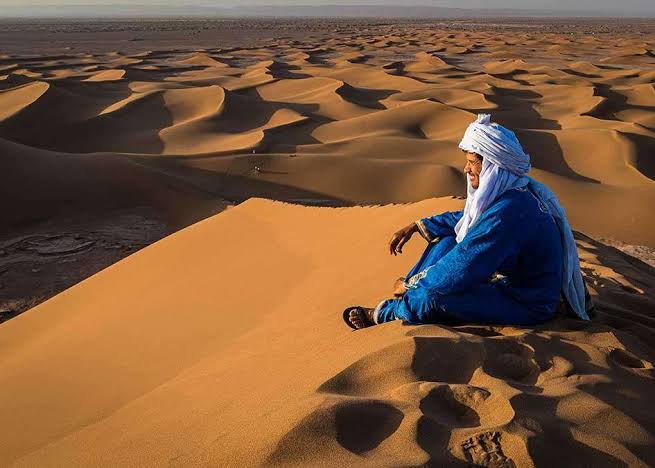
In short: In Merzouga you choose between village hotels and kasbahs (from around 30-80 EUR, with pools, walls, and easy road access) or desert camps pitched among the Erg Chebbi dunes (roughly 60-250 EUR per person with a camel ride and dinner included). Hotels suit slow, comfortable stays; camps are for the one unforgettable night under the stars.
Comparing camps? See all our Agafay desert camps, how to choose the right camp and the Agafay day pass guide.
Where exactly is Merzouga, and what are your two options?
Merzouga is a small village on the western edge of Erg Chebbi, a sea of dunes rising up to 150 metres near Morocco’s border with Algeria. It sits about 470 km south of Fez (7-8 hours by road) and around 560 km from Marrakech (9-10 hours, usually via Ouarzazate and the Dades or Todra gorges), which is why Marrakech trips are almost always sold as 3-day/2-night tours rather than one long day. Once you arrive, accommodation splits into two clear families: fixed hotels and riads inside or beside the village, and tented desert camps out on the sand. Most visitors combine both, or pick one based on how much comfort versus adventure they want.
What are Merzouga’s hotels and kasbahs like?
Village and dune-edge hotels are permanent buildings, often built in earth-toned kasbah style with thick walls that stay cool. Budget guesthouses start around 20-35 EUR per double room, mid-range hotels with a pool and terrace run 40-80 EUR, and a handful of upscale properties reach 100-150 EUR. Nearly all sit within a few kilometres of the dunes, so you still get sunrise views without sleeping on sand. This is the smart choice if you are travelling with young children, want reliable Wi-Fi and hot showers, are visiting in the July-August heat when nights stay warm, or simply want a base for several nights of gorge trips, fossil hunting, and 4×4 excursions.
What is a night in a desert camp actually like?
Desert camps are clusters of tents pitched in the dunes, reached by a roughly one-hour camel trek led at walking pace or a short 4×4 transfer at sunset. Standard camps (around 60-90 EUR per person) offer shared or simple private tents, communal bathrooms, a tagine dinner, and Berber drumming around the fire. Luxury camps (150-250 EUR per person) give you en-suite tents with real beds, rugs, private bathrooms, and sometimes plunge pools. The price almost always includes the camel ride out, dinner, breakfast, and the transfer back. Waking before dawn to climb a dune and watch the sun rise over the Algerian horizon is the moment most travellers remember for years. For the full picture of dune trips across the country, see our Morocco Desert guide.
Hotel or camp: which should you book?
Choose a hotel if you value comfort, are staying two or more nights, travel in peak summer, or have mobility concerns that make camel trekking awkward. Choose a camp if the desert night is the whole point of your trip and you want silence, stars, and dunes at your tent door. The most popular plan is one or two nights in a village hotel plus a single night in a camp, giving you both a comfortable base and the signature dune experience. If you want to compare this with Marrakech’s much closer alternative, the Agafay stone desert is only about 40 minutes from the city and works well as a shorter escape.
When is the best time to stay in Merzouga?
The sweet spot is mid-September to mid-November and March to April, when days are warm (20-30 C) and nights are cool but comfortable. Winter (December-February) brings pleasant days but cold nights that can drop near freezing in the dunes, so camps provide heavy blankets. Summer (June-August) is intense, with daytime highs above 40 C; many travellers then favour air-conditioned hotels over tents. Book camps a few weeks ahead for the autumn and spring peaks, especially around Easter and the year-end holidays.
How do you get to Merzouga and your accommodation?
Most people arrive on a multi-day tour from Marrakech or Fez, on a shared or private transfer, or by driving the well-paved N9 and R702 roads. There is no train; the nearest useful hub is Errachidia, about 130 km north, with a small airport and bus links. Camps and hotels will confirm a meeting point in the village, from where camels or 4x4s take you to a camp. For village stops, packing tips, and local logistics, our related guide covers the practical details.
Frequently Asked Questions
Is it safe to sleep in a Merzouga desert camp? Yes. Established camps are staffed overnight, use fixed sites licensed by local authorities, and have hosted travellers for decades without issue.
How much does one night in a desert camp cost? Standard camps run about 60-90 EUR per person and luxury camps 150-250 EUR, usually including the camel ride, dinner, breakfast, and transfers.
Do camps have bathrooms and electricity? Most standard camps have shared bathrooms and solar-powered lighting; luxury camps offer private en-suite tents with hot water and charging points.
Can I do both a hotel and a camp in one trip? Absolutely, and it is the most popular choice: a night or two in a village hotel plus one night in a dune camp gives you comfort and the classic desert experience.
Do I need to book in advance? In peak seasons (spring and autumn, plus Easter and New Year), yes, ideally a few weeks ahead; in low season you can often arrange a camp on arrival.
👉 Planning your trip? Ask our local agency on WhatsApp.
Ready to book this trip? We run it as a private tour: 3 Days from Marrakech to Fes via Merzouga Desert. Message us on WhatsApp for dates and a quote.