
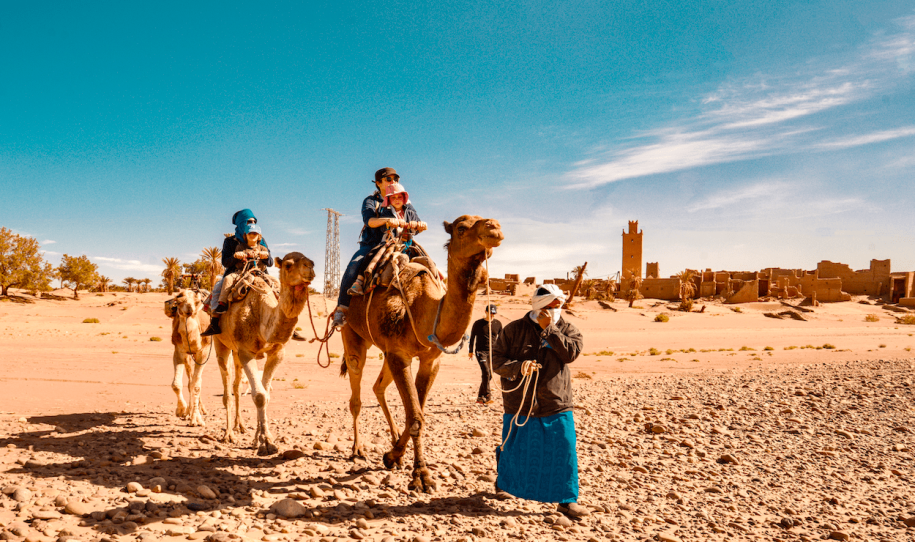
All our tours are private. These prices are for a private experience, not a shared group. We confirm the exact price on WhatsApp; you book directly with the local families and camps, no middlemen.
In short: Amezrou is a palm-shaded village just 2-3 km south of Zagora, famous for its old Jewish quarter (mellah) and centuries-old silversmith tradition. It makes an easy, worthwhile half-day stop on any Draa Valley or Erg Chigaga desert trip.
Where is Amezrou, exactly?
Amezrou sits on the southern edge of Zagora, roughly 2-3 km from the town centre along the road toward M’Hamid. Zagora itself is about 360 km and around 7 hours’ drive from Marrakech, usually done as a 2-day tour over the Tizi n’Tichka pass and through Ouarzazate. If you are coming from the deep dunes at Merzouga (Erg Chebbi, ~150 m tall), Zagora and Amezrou lie on the western route toward Erg Chigaga, the more remote sea of dunes reached by 4×4 from M’Hamid. Amezrou is the kind of place you reach in ten minutes from your Zagora riad, not a destination you cross the country for, so pair it with the wider Draa Valley.
Why is it called the “Jewish Kasbah”?
For centuries the Draa Valley was home to a significant Jewish population, and Amezrou held one of the region’s best-known mellahs (Jewish quarters). The community were master silversmiths and traders, and Amezrou became a hub for jewellery, khôl containers, and the heavy Berber pieces you still see in Moroccan souks. Most families emigrated in the mid-20th century, largely to Israel and France, so the quarter is no longer a living Jewish community. What remains is the earthen architecture, the old synagogue building, and workshops where Muslim artisans learned the craft directly from their Jewish neighbours and kept it alive. Walking the shaded lanes, you feel the layered history rather than a museum-piece reconstruction.
What is there to see and do?
The highlight is a slow wander through the mellah’s narrow, mud-brick alleys, ideally with a local guide who can point out the former synagogue and explain the silversmithing lineage. Several artisan workshops welcome visitors; you can watch silver being worked and, if you like a piece, buy directly. Amezrou is also wrapped in a genuine working palm grove (palmeraie), so it pairs naturally with a short walk among the date palms and irrigation channels of the oasis. It is unhurried and small-scale. Give it 1-2 hours, or half a day if you combine the kasbah, a workshop visit, and a stroll in the palmeraie.
When should I visit?
The comfortable season for the whole southern desert region, Amezrou included, runs October to April. In those months days are warm and pleasant and the palm grove is a delight. Summer is punishing here: temperatures regularly climb past 40°C in the Draa, which makes midday walking through the mellah genuinely hard work. If you must come in summer, go early morning or late afternoon. In winter, days stay mild but desert nights get cold, so bring a warm layer if you are continuing to a camp near Erg Chigaga.
How do I fit it into a desert trip?
Amezrou slots neatly into a Zagora or Draa Valley itinerary. A classic pattern is Marrakech to Zagora on day one, an overnight in a riad or a nearby dune bivouac, then Amezrou and the palmeraie the next morning before heading back or pushing on to M’Hamid and Erg Chigaga. It is not on the main Merzouga circuit, so if your heart is set on the tallest dunes you would visit Amezrou on a separate Zagora-focused trip rather than the standard 3-day Merzouga loop (shared tours for which run roughly 80-150 EUR per person). Note that Amezrou is a real oasis village, quite different from the Agafay stone desert 40 minutes from Marrakech, which is rocky hills with no dunes at all.
Is a guide worth it?
Yes. The mellah is easy to walk, but its interest is almost entirely in the stories, the who-lived-here and how-the-silver-was-made details that you simply cannot read off the walls. A local guide (often arranged through your Zagora accommodation) turns a pretty ten-minute stroll into a memorable hour, and can introduce you to a working silversmith. It is one of those stops where context is everything.
Frequently Asked Questions
How far is Amezrou from Zagora? About 2-3 km south of the town centre, roughly a 10-minute drive or a short taxi ride toward the M’Hamid road.
Is there still a Jewish community in Amezrou? No. The Jewish families largely emigrated in the mid-20th century. The mellah, old synagogue building, and silversmithing tradition remain, but it is no longer a living Jewish community.
Can I buy silver jewellery there? Yes, several artisan workshops in and around the mellah let you watch the work and buy directly. Bargain politely and pay in cash.
How long should I spend in Amezrou? Plan on 1-2 hours for the kasbah and a workshop, or half a day if you add a walk through the palm grove.
Is Amezrou near the big dunes? Not the tallest ones. Erg Chebbi (~150 m) is at Merzouga, far to the east. Amezrou is closer to Erg Chigaga, the remote dunes reached by 4×4 from M’Hamid, southwest of Zagora.
For the bigger picture, see our Morocco Desert guide, and for this specific region read our related guide to the Zagora desert.
👉 Planning your trip? Ask our local agency on WhatsApp.
Planning your trip? Explore our Morocco desert tours from Marrakech, 3-day Marrakech to Merzouga tour and 2-day Zagora tour.