
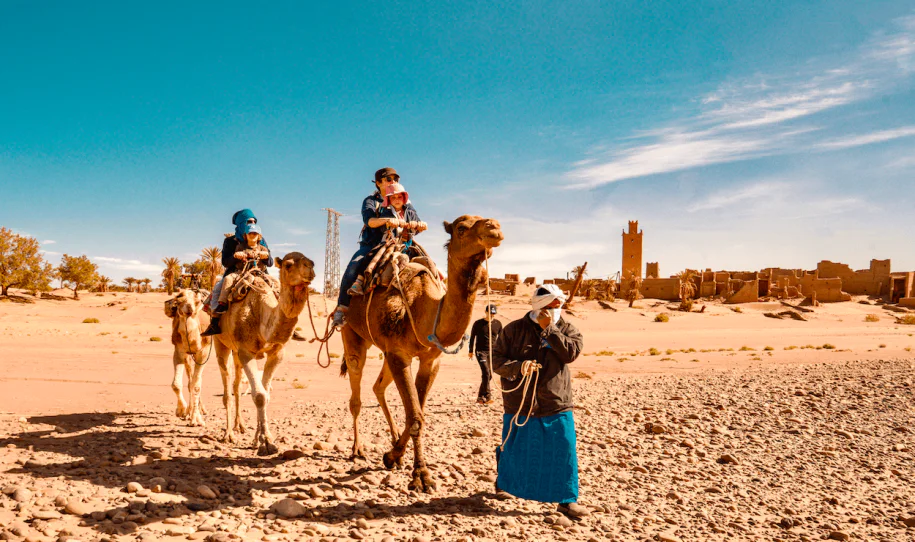
In short: Nkob (also spelled N’Kob) is a small oasis village on the southern flank of the Anti-Atlas in Morocco, famous for having more kasbahs than almost anywhere else in the country. It sits on the scenic road between Ouarzazate and the Draa Valley, and makes a quiet, authentic stop for travelers heading toward the Sahara.
Where exactly is Nkob, and why the “thousand kasbahs” name?
Nkob lies in the Zagora province, tucked below the Jbel Saghro mountains where the High Atlas gives way to pre-Saharan plains. The village is often nicknamed the “village of a thousand kasbahs” because an unusually high number of fortified earthen homes, more than forty by most local counts, cluster along its palm groves. The figure “thousand” is poetic rather than literal, but stand on any rooftop at dusk and the density of crenellated pisé towers, all glowing the same reddish clay as the earth around them, makes the exaggeration feel earned. These kasbahs were built by different families and tribes over generations, which is why they cluster so tightly.
How do I get to Nkob?
Most travelers reach Nkob by road as part of a wider desert loop. From Ouarzazate it is roughly a two-hour drive southeast, and the village sits on the N12 route that connects Ouarzazate/Agdz toward Rissani and the Tafilalet. If you are doing the classic Marrakech to Merzouga circuit, around 560 km and 9 to 10 hours split over a 3-day tour, Nkob is a natural detour off the main Draa Valley corridor. From Zagora, the palm-lined heart of the Draa, it is a manageable half-day of driving through the Jbel Saghro foothills. There is no train and no airport nearby, so a private car, grand taxi, or organized tour is how you will arrive.
What is there to do once you are there?
Nkob rewards slow travel more than a checklist. Walking the palmeraie footpaths past the old kasbahs is the main pleasure, ideally early morning when the light is soft and the irrigation channels are running. The village is also a recognized trailhead for treks into the Jbel Saghro, a rugged volcanic massif that mule-caravan nomads still cross; multi-day walks here are far quieter than the busier Toubkal routes farther north. A modest weekly souk brings in Berber farmers and herders from the surrounding douars, and it is one of the more genuine market experiences in the region because it caters to locals rather than tour buses. I found an afternoon here best spent with mint tea on a terrace, watching the Saghro peaks change color.
How does Nkob fit into a Sahara trip?
Think of Nkob as a peaceful counterpoint to the big dune destinations rather than a replacement for them. The tallest Saharan dunes in Morocco, Erg Chebbi near Merzouga at around 150 m, and the remote Erg Chigaga near M’Hamid reached by 4×4, are still several hours further southeast. Nkob works beautifully as an overnight or lunch stop that breaks up the long transfer and lets you sleep somewhere calm before the desert crowds. If your itinerary is shorter, the Marrakech to Zagora run of about 360 km and roughly 7 hours on a 2-day tour passes through the same Draa corridor, and Nkob can be folded in with a bit of planning. For the full picture of routes and dune fields, see our Morocco Desert guide, and for the nearer palm-valley option read the related guide.
When should I visit?
The comfortable window is October to April, when daytime temperatures are pleasant for walking and photography. Summer here is genuinely harsh, with pre-Saharan heat routinely pushing past 40C, which makes midday sightseeing and any Saghro trekking unwise. Winter flips the other way: days stay mild but nights get cold, so if you overnight in a kasbah guesthouse between December and February, pack a warm layer. Spring and autumn hit the sweet spot for both the village and onward desert travel.
What does it cost and where do I stay?
Nkob has a handful of restored-kasbah guesthouses and small hotels that trade on character rather than luxury, with rooms typically in the budget-to-mid range for rural Morocco. Meals are simple and inexpensive tagines and couscous. Because Nkob is usually a leg within a larger trip, the bigger cost is the tour itself: a shared 3-day Merzouga desert tour generally runs around 80 to 150 EUR per person, while private cars with a detour to Nkob cost more depending on group size. Always confirm what is included before booking.
Frequently Asked Questions
Is Nkob worth visiting? Yes, if you value authentic villages and quiet over famous dunes. It is one of the best-preserved kasbah landscapes in southern Morocco and a genuine, uncrowded stop.
How far is Nkob from Merzouga? It is several hours by road, as Merzouga and Erg Chebbi sit much further southeast; most people treat Nkob as a stop on the way rather than a day trip from the dunes.
Are there sand dunes at Nkob? No. Nkob is an oasis and mountain-foothill village. For the tall Saharan dunes you need Erg Chebbi at Merzouga or Erg Chigaga near M’Hamid.
Can I trek from Nkob? Yes. Nkob is a classic starting point for treks into the Jbel Saghro massif, best attempted from autumn through spring to avoid extreme heat.
Do I need a 4×4 to reach Nkob? No. The village is on a paved road accessible by ordinary car; a 4×4 is only needed for off-road tracks and remote dunes like Erg Chigaga.
👉 Planning your trip? Ask our local agency on WhatsApp.
Planning your trip? Explore our Morocco desert tours from Marrakech and 2-day Zagora tour.