
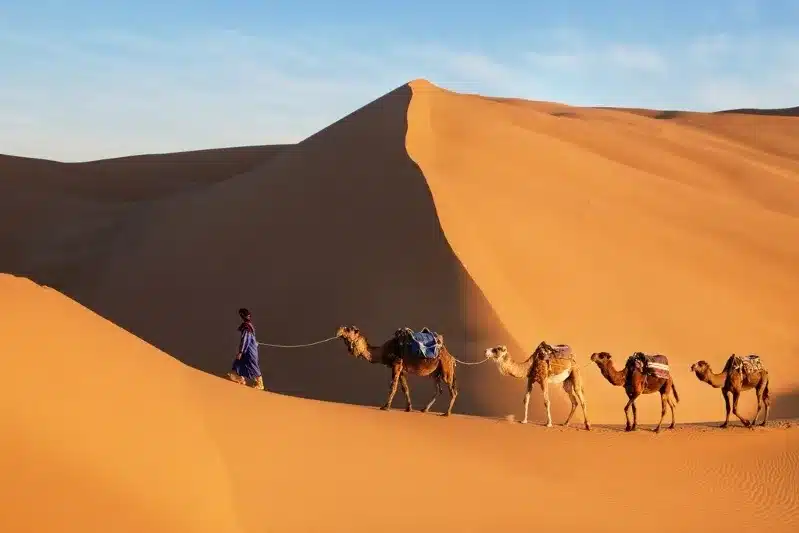
In short: The Moroccan Sahara is far from lifeless: dromedary camels, fennec foxes, desert hedgehogs, sand-coloured lizards, scorpions and dozens of migratory birds all live here. On a normal desert tour you will reliably see camels, small reptiles and birds around the Erg Chebbi and Erg Chigaga dunes, while the rarest mammals (fennecs, jerboas) are nocturnal and shy, so an overnight in a desert camp is what tips the odds in your favour.
Planning a desert trip? See all private Morocco desert tours from Marrakech.
What Sahara desert animals will you actually see?
On a typical trip to the dunes near Merzouga (about 560 km and a 9-10 hour drive from Marrakech, usually done as a 3-day tour) or to Zagora, the daytime wildlife is modest but memorable. Dromedary (one-humped) camels are everywhere, used for the sunset and sunrise treks into the dunes. In the cool of early morning you will spot agama lizards basking on warm rocks, ground squirrels darting between tamarisk shrubs, and skittish desert larks working the flat ground between camps. After rain, the seasonal Dayet Srji lake just west of Merzouga fills and draws flamingos and waders, usually best from February to April. What we tell guests: the desert looks empty at midday because almost everything is sheltering from the heat, so the animals come out at the exact hours you are in camp at dawn and dusk.
Which iconic desert mammals live here?
The animal most travellers hope to glimpse is the fennec fox, the world’s smallest fox, recognisable by its oversized ears that shed heat and pick up the sound of insects underground. Fennecs are strictly nocturnal and rarely seen, but a good camp guide can often show you their delicate tracks looping around the tents at dawn, and occasionally a pair will pass the firelight. Other native mammals include the jerboa (a long-legged hopping rodent you sometimes catch in a headlamp beam), the Cape hare, the desert hedgehog, and sand cats in the deeper desert. Historically the region held addax antelope and dorcas gazelles; dorcas gazelles still survive in protected zones, while the scimitar-horned oryx, once extinct in the wild, has been reintroduced to reserves in the wider Sahel.
What reptiles, insects and dangers should you know about?
Reptiles rule the daytime desert. You may see spiny-tailed lizards (locally “dhab”), sandfish skinks that “swim” through the loose sand, and the horned viper, whose sidewinding tracks look like a rope dragged across a dune. Scorpions, including the potent fat-tailed scorpion, shelter under stones and emerge at night. The practical rules are simple and worth following from the first evening: never put hands or feet where you cannot see, shake out shoes and bedding in the morning, and carry a torch after sunset. Serious incidents are genuinely rare, camps keep first-aid supplies, and in years of trips the commonest “wildlife” complaint is a curious beetle in a tent. For a fuller safety and packing overview, see our Morocco Desert guide.
Is the Moroccan Sahara good for birdwatching?
Yes, surprisingly so. The desert edge is a migration corridor between Europe and sub-Saharan Africa, and Merzouga is one of Morocco’s top birding spots. Specialist targets include the desert sparrow (often nesting in the village kasbahs themselves), the cream-coloured courser, spotted sandgrouse coming to drink at dawn, the brown-necked raven, and the Egyptian nightjar. Peak migration runs March-April and September-October. A short dawn outing with a local birding guide, often bundled into a camp package or a modest half-day rate, can turn up a dozen desert species around the lake and scrub. Bring binoculars and start before sunrise, because once the heat builds the birds drop into cover.
When and where are your best chances to see wildlife?
Timing matters more than luck. The comfortable season is October to April, when daytime highs sit around 20-25 C and animals are active; summer temperatures well above 45 C send most wildlife into hiding and make midday treks miserable. Winter nights can drop close to freezing, so the animals (and you) are liveliest in the golden hour after sunrise and before sunset. For variety, Erg Chebbi (Merzouga) offers the lake, the tall dunes and the birdlife, while remote Erg Chigaga near M’Hamid, reached by 4×4, gives quieter terrain and better odds for nocturnal mammals. Staying overnight in a desert camp, rather than day-tripping, is the single biggest thing you can do to actually see the Sahara’s animals.
How can you watch wildlife responsibly?
Ethical viewing keeps these fragile populations safe. Keep your distance, never feed or chase animals, and do not handle reptiles for photos. Choose camps that treat their camels well, with real rest, shade and water between treks. Skip any “photo prop” animals kept on chains in the tourist squares of Marrakech. Stick to established tracks so vehicles do not crush burrows or the fragile ground crust, and carry all litter back out. Responsible operators brief guests on this at check-in; for planning options and camp comparisons, our Morocco Desert guide walks through what to look for.
What you will realistically see, ranked by likelihood
Most desert wildlife lists read like a zoo inventory and set visitors up for disappointment. Here is the honest version, based on what is actually out in the open during a normal trip to the dunes.
| Likelihood | Species | Where and when |
|---|---|---|
| Near certain | Dromedary camels | Everywhere, used for the sunset and sunrise treks |
| Near certain | Agama lizards | Basking on warm rocks in the cool of early morning |
| Very likely | Desert larks, brown-necked ravens | Flat ground and scrub between the camps |
| Likely | Ground squirrels | Darting between tamarisk shrubs |
| Possible at dawn | Spotted sandgrouse | Coming in to drink at first light |
| Possible, seasonal | Flamingos and waders | Dayet Srji lake west of Merzouga, after rain, best February to April |
| Possible with a guide | Desert sparrow | Often nesting in the village kasbahs themselves |
| Uncommon | Fennec fox, jerboa | Nocturnal; tracks around the tents at dawn are the usual sighting |
| Rare | Sand cat, desert hedgehog, Cape hare | Deeper desert, at night |
| Very rare | Dorcas gazelle | Surviving in protected zones only |
Read that table as expectation management. A first-time visitor who hopes for camels, lizards and birds will come home happy. One who expects a fennec fox on demand will not.
Wildlife by time of day
In the desert, the hour matters more than the place. The same dune field can look sterile at noon and busy at six in the morning.
| Time | What is active | What to do |
|---|---|---|
| Before sunrise | Sandgrouse heading to water, nocturnal tracks still fresh | The single best hour. Be out before the light. |
| Early morning | Lizards basking, ground squirrels, small birds feeding | Walk slowly along the scrub edge rather than the open sand |
| Midday | Almost nothing | Shelter, like everything else is doing |
| Late afternoon | Birds return, reptiles reappear | Good second window, and the best light |
| Dusk | Insects, then the animals that eat them | Stay near camp and keep a torch on you |
| Night | Fennecs, jerboas, scorpions | Walk with a guide, scan with a head torch |
This is the real argument for sleeping in a desert camp rather than day-tripping. The two productive windows, before sunrise and at dusk, both fall outside the hours a day visitor is present.
Wildlife by month
| Period | Conditions | What it is good for |
|---|---|---|
| October to November | Daytime around 20-25 C | Comfortable walking, active animals, autumn bird migration tailing off |
| December to January | Mild days, nights near freezing | Sharp light and tracks in cold sand; bring serious layers |
| February to April | Warming, lake may hold water | The best stretch: flamingos and waders at Dayet Srji, peak migration in March and April |
| May to September | Well above 45 C | Avoid for wildlife. Most animals stay hidden and midday treks are miserable. |
Peak bird migration runs March to April and again September to October, when the desert edge works as a corridor between Europe and sub-Saharan Africa. If birds are the point of your trip, build the dates around those two windows. Our guide to the Morocco desert in November covers what the shoulder season feels like on the ground.
Four habits that keep the desert harmless
Scorpions and horned vipers live here, and serious incidents are genuinely rare. The difference is almost entirely down to routine.
- Never put hands or feet where you cannot see. Not under stones, not into rock gaps, not into an unchecked bag left on the ground.
- Shake out shoes and bedding every morning. This is the one habit that matters most, and it takes ten seconds.
- Carry a torch after sunset. Scorpions shelter under stones by day and move at night; you simply need to see the ground.
- Do not handle reptiles. Not for a photograph, not because a guide offers. A horned viper’s sidewinding track across a dune is the better picture anyway.
Camps keep first-aid supplies, and in practice the commonest wildlife complaint is a curious beetle in a tent. Treat the four habits as non-negotiable and the rest takes care of itself.
What actually improves your odds
- Stay overnight. Nothing else comes close. It is the only way to be present at dusk and before dawn.
- Bring binoculars. Desert birds keep their distance, and without binoculars most of the list above is a brown smudge.
- Hire a local birding guide for one dawn. Often bundled into a camp package or available at a modest half-day rate, and a dozen desert species around the lake and scrub is a realistic morning.
- Pick Erg Chigaga if nocturnal mammals are the goal. Reached by 4×4 near M’Hamid, it is quieter terrain with better odds than the busier dunes.
- Pick Erg Chebbi if birds are the goal. Merzouga has the seasonal lake, the kasbah sparrows and the tall dunes in one place.
What a wildlife trip to the Sahara costs
From Marrakech, Merzouga is roughly 560 km and a 9 to 10 hour drive, which is why it is normally sold as a 3-day tour. A shared 3-day tour typically runs around 80 to 150 EUR per person depending on group size and camp comfort. You can also reach Merzouga by coach: Supratours and CTM both run the route, often overnight, with fares in the low tens of euros one way, and our bus to Merzouga guide explains the trade-off.
Agafay is not a wildlife destination, and we will not pretend otherwise
Visitors short on time often ask whether the Agafay desert near Marrakech can stand in for the Sahara. For wildlife, the honest answer is no. Agafay is a stone desert of bare hills, about 30 km and 40 minutes southwest of the city. It has no sand dunes, no Erg Chebbi, and none of the seasonal lake that makes Merzouga a birding site.
What Agafay does offer is the landscape, a sunset over the hills and a dark sky, all inside an afternoon. If that is the trip you have time for, these are our published prices:
| Experience | Price | Charged per |
|---|---|---|
| Private transfer Marrakech ↔ Agafay | 80 EUR | Vehicle, up to 6 passengers |
| Camel ride | From 30 EUR | Person |
| Quad biking | From 30 EUR | Person |
| Dinner with show | From 45 EUR, luxury version 55 EUR | Person |
| Swimming pool day pass | From 65 EUR | Person |
| Hot-air balloon over Marrakech | 185 EUR | Person |
Transfers are billed per vehicle, never per person, up to six passengers, so two people pay the same 80 EUR as six. That 80 EUR rate covers the Marrakech to Agafay corridor only. Longer runs are priced separately, again per vehicle: Casablanca, Essaouira and Agadir 250 EUR each, Taghazout 320 EUR, Rabat 400 EUR.
Who should not plan a wildlife trip here
- Anyone expecting a safari. The Sahara is not East Africa. There are no herds and no predators to watch from a vehicle. The pleasure is in small, quiet sightings.
- Day-trippers. If you cannot stay a night, you will miss both active windows and see camels, lizards and a few birds. That is a fine trip, but it is not a wildlife trip.
- Late risers. The best hour is before sunrise. If a 5 am start is out of the question, adjust your expectations rather than your alarm.
- Summer travellers. Above 45 C the desert empties out. Shift the dates to October-April if wildlife matters to you.
- Anyone who wants to touch or hold the animals. Responsible camps will say no, and so should you.
For routes, camp styles and timings across the whole season, see our Morocco Desert guide, or the camp guide if you are weighing where to spend the night.
Frequently Asked Questions
Are there scorpions and snakes in the Moroccan Sahara? Yes, including fat-tailed scorpions and horned vipers, but they avoid people. Watch where you step, use a torch at night, and shake out shoes and bedding in the morning.
Can I see a fennec fox on a normal desert tour? It is possible but uncommon, since fennecs are nocturnal and shy. Your best chance is an overnight camp with a guide who can track them near the dunes at dawn or dusk.
What large animals live in the Sahara? Wild dorcas gazelles survive in protected areas, and dromedary camels are widespread as domesticated animals. Big wild mammals are otherwise rare and easily disturbed.
Is Merzouga good for birdwatching? Very good. The seasonal Dayet Srji lake attracts flamingos and desert specialists, with peak migration in March-April and September-October.
When is the best time to see desert wildlife? October to April, at dawn and just after sunset. Summer heat above 45 C keeps most animals hidden during the day.
What is the single best way to see more desert wildlife? Sleep in a desert camp. The two productive windows, dusk and the hour before sunrise, both fall outside the time a day visitor is on site.
Are there wild animals to see in the Agafay desert near Marrakech? Agafay is a stone desert of bare hills about 40 minutes from Marrakech, with no dunes and no seasonal lake. It is worth visiting for the landscape and the night sky, not for wildlife.
What should I bring for desert wildlife watching? Binoculars, a head torch, warm layers for dawn and dusk, and the patience to be outside before first light.
What does a wildlife-focused desert trip cost? A shared 3-day Merzouga tour typically runs around 80 to 150 EUR per person. For an Agafay afternoon instead, a camel ride starts at 30 EUR per person and the private transfer from Marrakech is 80 EUR per vehicle for up to six passengers.
👉 Planning your trip? Ask our local agency on WhatsApp.