
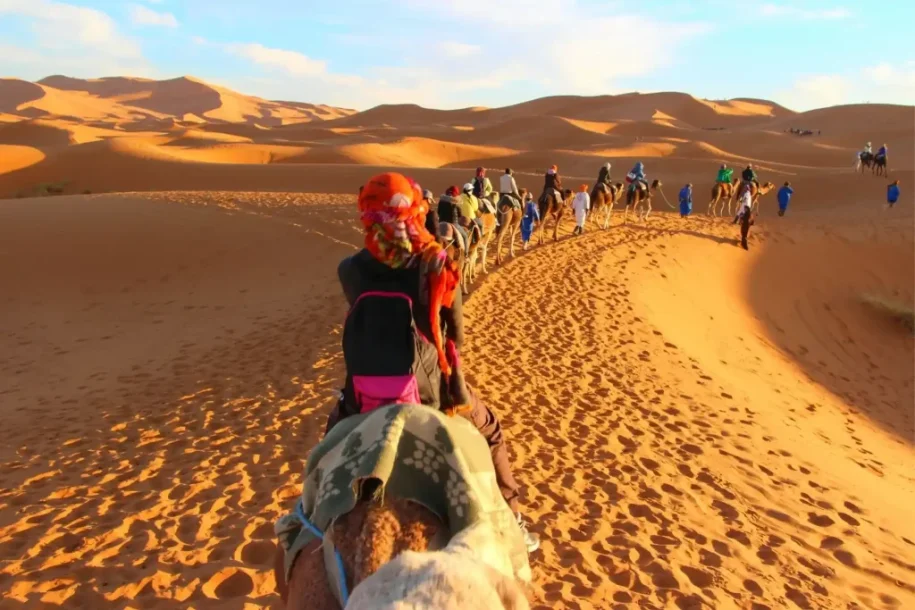
In short: The Marathon des Sables is a roughly 250 km, six-stage foot race across the Moroccan Sahara near Merzouga and the Erg Chebbi region, run every spring when temperatures are manageable. Competitors carry their own food and gear for about a week, and most fly into Ouarzazate or drive out from Marrakech (~560 km, 9-10h) before transferring to the desert start.
Planning a desert trip? See private Morocco desert tours from Marrakech or our Agafay Desert guide.
What exactly is the Marathon des Sables?
The Marathon des Sables (“Marathon of the Sands”) is a self-sufficiency ultramarathon held in southern Morocco. Over six stages and roughly a week, runners cover around 250 km on foot across dunes, dried lake beds, rocky plateaus and stony passes. The defining rule is self-sufficiency: you carry everything on your back except water and a shared bivouac tent. That means your food, sleeping bag, stove and safety kit all ride in a pack that typically weighs 6.5-10 kg at the start. Walking into camp after a long stage, watching the low Saharan sun set over the ridgelines, is the kind of moment people plan years around.
Where in Morocco does it take place?
The race moves each year, but it is anchored in the southeast Sahara, usually within reach of Merzouga and the Erg Chebbi dune sea, where the tallest dunes rise to about 150 m. The course threads between true sand seas and the hard, flinty ground of the pre-Sahara. This is a different landscape from the Agafay “desert” 40 minutes from Marrakech, which is rocky stone terrain, not dunes. It also differs from the remote Erg Chigaga dunes near M’Hamid, reached by 4×4. If you want to understand how these regions connect, our Morocco Desert guide maps them out clearly.
When is it held and what is the weather like?
The event runs in spring, most commonly in April, and that timing is deliberate. The broader best season for the Moroccan desert is October to April, when days are pleasant and skies are clear. In summer, daytime highs push past 40C, which would make a self-carried ultra brutal and dangerous. Even in the race window, expect a punishing swing: hot, exposed afternoons on the dunes, then genuinely cold desert nights, the same chill that catches out winter travelers who assume the Sahara is always warm. Sun, wind and blown sand are constant companions, so eye protection and gaiters are non-negotiable.
How do you get to the start line?
Most international runners fly into Casablanca or Marrakech, then continue toward Ouarzazate, the logistics hub for the race, before the organization shuttles everyone deep into the desert by bus and 4×4. If you are combining the race with your own travel, it helps to know the classic desert routes: Marrakech to Merzouga is about 560 km and 9-10 hours, usually done as a 3-day tour with an overnight in the Dades or Todra gorges; Fes to Merzouga is shorter at roughly 470 km and 7-8 hours; and Marrakech to Zagora is around 360 km and about 7 hours, popular as a 2-day trip. Whichever way you come, the last leg into the sand is always off-road.
Not a runner? How to experience the same desert
You do not need to enter a 250 km race to sleep under the Erg Chebbi stars. Shared 3-day Merzouga desert tours from Marrakech typically run in the range of about 80-150 EUR per person, covering transport, a night in a desert camp and a camel ride into the dunes. That gives you the sunrise-over-the-dunes payoff without the blistered feet. It is also the honest way to gauge the terrain: spend one afternoon walking soft sand in the heat and you will respect what MdS competitors do six days running. For trip-planning specifics, see our related guide.
Frequently Asked Questions
How long is the Marathon des Sables? It is roughly 250 km spread across six stages over about a week, including one long stage that many runners tackle overnight.
Do I have to carry my own food? Yes. The race is self-sufficient: you carry all your food and equipment for the duration, while the organization supplies rationed water and a communal tent each night.
What is the nearest desert town? The race is anchored in the southeast Sahara near Merzouga and Erg Chebbi, with Ouarzazate serving as the main gateway and logistics base.
Is April really the best time to be in the Moroccan desert? Spring falls inside the ideal October-April window, so conditions are far safer than summer, when highs exceed 40C. Just pack warm layers for the cold nights.
Can casual travelers visit the same dunes? Absolutely. A shared 3-day Merzouga tour (about 80-150 EUR per person) puts you in the same Erg Chebbi dunes without racing.
👉 Planning your trip? Ask our local agency on WhatsApp.